
A transit stray current study starts with drawings, asset records, and the decision the project needs to make. These inputs help identify assets at risk, suitable monitoring locations, and the parties who must be involved.
To plan a transit stray current study, gather six things: the project purpose, site and transit drawings, details of buried and electrically connected assets, operating and construction information, access arrangements, and the applicable review requirements. Here is what to collect before scoping begins.
Define the Project, Transit Interface and Study Purpose
First, explain why the assessment is needed. Is the project a new development near a subway or streetcar corridor? Are you protecting an existing foundation or buried utility? Or is there an observed corrosion concern that needs investigation?
State the property address, nearby transit line, approximate separation from transit infrastructure, and the decision the report must support.
Distinguish two concerns:
- D.C. stray current corrosion: In a direct-current traction system, some return current may leave its intended electrical path and travel through surrounding conductive materials. Corrosion can occur where current leaves a buried metallic asset and enters the surrounding electrolyte.
- Electromagnetic interference (EMI): Currents associated with transit and building systems may produce electromagnetic fields that affect susceptible equipment. This is an equipment-compatibility question, not the same mechanism as stray current corrosion.
The distinction informs what transit stray current studies assess. C-INTECH’s transit stray current studies can support development teams evaluating electrolysis and related interference issues near TTC infrastructure.
Provide Site Plans and Transit Infrastructure Information
Drawings are the starting point for assessing the relationship between a proposed structure and an electrified transit corridor. Share the latest available versions of:
- Survey and site plans: Property boundaries, transit rights-of-way, setbacks and the nearest known tracks, tunnels or substations.
- Architectural and structural drawings: Below-grade levels, foundation elevations, piles, caissons, retaining walls and permanent shoring.
- Civil and utility plans: Existing services, proposed connections, crossings and utility relocations.
- Construction drawings: Excavation limits, temporary support systems and significant changes planned near transit assets.
- Transit records, where available: Track alignment, traction-power equipment and relevant return-circuit arrangements.
Mark each document as available, requested, or not yet confirmed. Transit drawings and electrical information may be controlled by the transit authority and subject to permission or confidentiality arrangements.
For Toronto sites, the TTC’s property development guidance explains its technical review process for work near TTC infrastructure. Use it to confirm current submission instructions.
Describe Buried and Electrically Connected Assets
Distance alone does not define risk: current can follow connected conductive paths. Prepare an inventory of relevant metallic assets and, where known, identify their owners:
- Buried water, gas and other metallic pipes, including service connections.
- Reinforcing steel, structural steel, metallic piles and embedded components.
- Grounding and earthing systems, metallic cable sheaths and intentional bonds.
- Protective coatings, insulating joints and cathodic protection systems.
- Previous corrosion observations, repairs, electrical testing and available soil or groundwater records.
Connections matter. A pipeline and foundation may be linked through grounding or bonds, while an insulating joint may interrupt a conductive path.
The international standard IEC 62128-2:2013 addresses protective provisions against stray currents from D.C. traction systems, including possible effects on metallic components in the ground. It is not a universal Canadian development requirement.
These connections are part of the wider discussion of EMI and electrolysis risks in infrastructure. Existing geotechnical reports, soil resistivity information and corrosion surveys may be useful; whether new sampling is needed depends on the assets and agreed assessment scope.
Document Operating Conditions and Construction Phases
Train movements, traction loads, service frequency, and return-circuit configuration can affect measurements over time. Share known service patterns, planned line or substation changes, nearby transit work, and any existing operating records the authority permits you to use. Identify whether the study concerns existing or future conditions.
Temporary shoring, utility diversions and staged foundation works can change conductive pathways. Record relevant construction phases.
The Transportation Research Board’s stray current control guidebook provides broader technical context for the design, testing and management of D.C. rail stray current. Operating records help determine appropriate measurement locations and monitoring periods.
Agree on Access, Monitoring and Stakeholder Responsibilities
Monitoring depends on access, records and permission. Before fieldwork is scoped, clarify responsibilities:
- Developer and design team: Supply current drawings, the construction schedule, site access and a contact for project decisions.
- Transit authority: Confirm relevant infrastructure information, review requirements and permissions for work on or near its assets.
- Utility and asset owners: Identify their infrastructure, existing protection systems and any accessible records or test points.
- Study engineer: Determine suitable investigation methods, measurement locations, data needs and reporting limitations.
Depending on the scope, measurements of electrical potential may be correlated with transit activity to interpret changes.
Measurements on traction, utility, or other controlled electrical installations require the appropriate authorization and qualified personnel. The development team should coordinate access—not undertake electrical testing independently.
Separate Stray Current and EMI Workstreams
A project may need one assessment or both. Buried pipelines and sensitive laboratory instruments pose different questions.
For sensitive equipment, Magnetic field analysis can investigate sources and field conditions relevant to equipment operation. It does not determine whether stray D.C. current is contributing to corrosion of buried metal. A corrosion assessment does not establish equipment compatibility.
Document separate objectives and deliverables. The effects of electromagnetic interference in buildings should be evaluated using methods appropriate to the affected equipment.
Confirm Applicable Requirements and Deliverables
Stray current study requirements are project-specific. Confirm which transit agency, municipality, and asset owners have review or approval responsibilities. Confirm the submission stage and whether screening, monitoring or detailed assessment is expected.
For example, the TTC currently states that development or construction activity within 60 metres of existing or planned TTC infrastructure or rights-of-way must undergo a technical review. Its published Developer’s Guide lists a professional-engineer-prepared electrolysis and stray current study among the Level 1 and 2 technical review submission materials. These are TTC development review levels, not universal levels of stray current testing, and the exact current submission requirements should be confirmed with TTC.
Agree on report content, limitations, design recommendations, and any follow-up monitoring. Significant design changes may require reassessment.
Prepare a Study Request for C-INTECH
An initial request can identify available information and outstanding gaps.
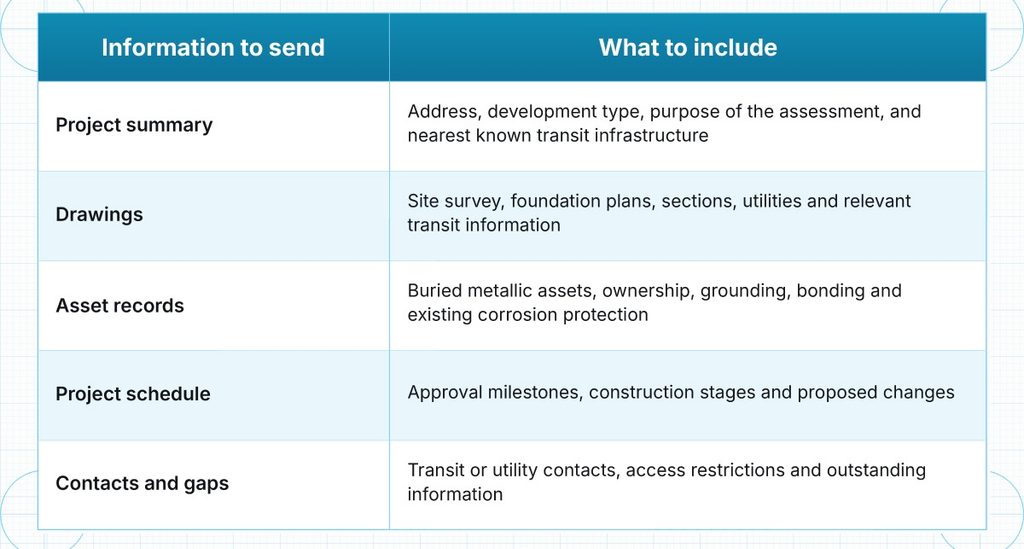
Label missing documents as unknown or pending, rather than assuming they are irrelevant. This helps determine the next requests and scope. To discuss a proposed transit electrolysis assessment or clarify the materials needed for your development, contact C-INTECH with the information currently available.
Frequently Asked Questions
1. Is a stray current study the same as a vibration assessment?
No. A stray current study evaluates unintended electrical current paths and potential corrosion of conductive assets. A vibration assessment evaluates ground-borne or structural movement caused by sources such as passing trains. A site may need both, but the methods and acceptance criteria differ.
2. Does a clean visual inspection rule out stray current corrosion?
No. Corrosion can affect buried or embedded metal that is not visible, and early-stage deterioration may not produce obvious surface signs. A visual inspection is useful context, but it cannot replace an appropriately scoped electrical and corrosion investigation.
3. Can a report prepared for one parcel cover a neighbouring development?
Not automatically. Neighbouring properties may have different foundations, utilities, electrical bonds, soil conditions and asset ownership. A previous report may provide background information, but its applicability to the new parcel must be evaluated.
4. Will the study author be able to certify another owner’s buried assets?
Not simply by issuing a report. The engineer can assess the assets and risks covered by the agreed scope, while certification, acceptance of modifications, and formal approvals remain subject to the relevant asset owner’s responsibilities and requirements.
5. Can electric vehicle chargers create the same corrosion concern as a D.C. railway?
Not automatically. D.C. charging equipment does not, by itself, have the traction-return arrangement of a D.C. railway. Any potential leakage or corrosion concern depends on the installation’s electrical design, grounding, faults, and actual current pathways, and requires a separate assessment.
6. Does an environmental site assessment normally replace a stray current study?
No. Environmental site assessments primarily investigate possible contamination of land or groundwater. For example, Ontario Regulation 153/04 defines objectives for phase one environmental site assessments that differ from investigating electrical current paths and corrosion. Environmental records may provide useful site information, but they do not answer the stray current question on their own.
