
A hospital installs new wireless equipment, and communication problems begin appearing in an adjacent department. In another building, a laboratory instrument produces inconsistent readings whenever nearby electronic systems are operating. RF interference could be responsible in either case, but identifying the actual cause requires more than reviewing the wireless equipment installed nearby.
RF signals can travel between rooms, reflect from metal surfaces, and enter sensitive equipment through unintended paths. When multiple communication systems operate in the same facility, finding what causes signal disruptions can be difficult. Engineers may need to examine RF activity on-site to determine where the problem originates. For projects involving an MRI installation, EMF interference studies can assess nearby RF and magnetic sources against the scanner manufacturer’s siting requirements.
What is a radio frequency survey, and what information does it provide?
During an RF survey, engineers measure signals at selected points throughout a site, checking their frequencies, field levels, and variations between locations and operating conditions. Engineers use the findings to investigate interference, assess exposure conditions, evaluate equipment locations, and determine whether corrective measures are necessary.
This article explains what RF surveys measure, how the testing is performed, and why the results matter for healthcare facilities, laboratories, telecommunications systems, and commercial buildings.
What Is a Radio Frequency Survey?
A radio frequency survey is a planned investigation of RF energy within a building, outdoor site, or defined equipment area. Engineers collect measurements to understand which signals are present, how their levels vary, and whether they may affect people, equipment, or communication systems.
RF surveys can investigate emissions from wireless access points, antennas, transmitters, communication equipment, and electronic devices.
The purpose of the investigation determines what is measured. For example, a facility experiencing wireless communication failures may need frequency-selective testing to identify competing signals. When the purpose is to evaluate human exposure to RF energy, engineers collect field measurements and perform calculations using the exposure limits relevant to the site.
Although both assessments involve RF measurements, the testing methods differ according to what needs to be evaluated.
C-INTECH conducts radio frequency surveys to help project teams locate RF sources, investigate possible interference, and understand signal conditions within buildings and specialized facilities.
How RF Surveys Differ From General Electromagnetic Testing
An RF survey concentrates on radio-frequency emissions and their behaviour within a particular environment.
Broader electromagnetic field testing may also investigate low-frequency magnetic fields associated with transformers, electrical feeders, switchgear, and other power distribution infrastructure. For proposed power distribution equipment, magnetic field analysis can complement the RF survey by modelling expected low-frequency magnetic conditions before installation.
Different frequencies require different testing equipment. For example, a meter designed to measure 60 Hz magnetic fields may not be capable of detecting RF signals in the megahertz or gigahertz range.
The survey must be designed around the source, relevant frequencies, and technical problem being investigated.
What Does an RF Survey Measure?
An RF assessment can produce several types of information. Field strength alone may not explain why a particular device is experiencing interference or whether measured conditions satisfy a project requirement.
RF Field Strength and Power Density
RF field strength describes the magnitude of an electromagnetic field at a measurement location.
Engineers commonly measure electric field strength in volts per metre (V/m). RF magnetic field strength may also be measured, typically in amperes per metre (A/m), when relevant to the assessment.
Power density, expressed in watts per square metre (W/m²), is another parameter used in RF exposure evaluations.
However, these quantities are not interchangeable under all conditions.
Close to an antenna or other RF source, electric and magnetic fields may not have the relationship assumed for a propagating plane wave. When measurements are taken close to an RF source, estimating power density from electric field strength using equations intended for far-field conditions may lead to inaccurate results.
Health Canada’s technical guidance for Safety Code 6 specifically distinguishes near-field from far-field measurement conditions. The appropriate assessment method must account for the source geometry, frequency, and measurement distance.
Frequency and Spectrum Content
An overall RF reading can show that electromagnetic energy is present without identifying which signals contribute to it.
Spectrum analysis provides more detail by examining RF energy across individual frequencies or frequency bands.
Engineers may use this information to investigate:
- Occupied Channels: Frequency channels currently carrying transmissions from wireless or communication equipment.
- Unexpected Emissions: RF signals detected at frequencies where the equipment is not expected to transmit.
- Harmonics: Additional frequency components found at whole-number multiples of the original signal frequency.
- Broadband Noise: RF energy spread over a broad range of frequencies instead of being concentrated at a single frequency.
For example, two systems may operate near the same frequency without necessarily interfering with one another. Whether they can coexist depends on factors such as signal level, channel separation, receiver characteristics, modulation, and system design.
Frequency-specific measurements help engineers determine whether further investigation is justified.
Spatial and Time-Based Variation
RF signal strength can differ considerably between areas of the same building.
Signals are often stronger closer to transmitting equipment, while walls and other construction materials may reduce their strength. Reflections from metal surfaces can also cause higher readings in certain locations.
To examine these differences, engineers collect measurements at several points, including different floors, corridors, technical rooms, occupied spaces, and outdoor areas.
When interference occurs only occasionally, measurements recorded over time can help identify when RF activity changes and whether those changes coincide with the reported problem.
Wireless traffic, machinery operation, transmitter duty cycles, and other changing conditions can influence the readings.
For instance, interference that appears only during a production shift may require measurements while the relevant machinery is operating.
Mapping the locations and timing of these changes helps connect RF activity with possible sources.
How Is a Radio Frequency Survey Performed?
An effective RF survey starts with the engineering question that needs to be answered. The measurement procedure should be specific enough to investigate the suspected problem without collecting unnecessary data.
1. Establish the Survey Objective
Engineers begin by examining the reported issue, reviewing the site’s conditions, identifying the equipment involved, and checking the technical criteria that apply to the assessment.
For an interference investigation, useful information may include when the problem occurs, which equipment is affected, and whether the symptoms began after an installation or operational change.
For an exposure assessment, the review considers accessible areas, known transmitting equipment, operating conditions, and applicable exposure criteria.
This initial review determines the frequency range, measurement locations, and instrument capabilities required.
2. Inspect the Site and Identify Possible RF Sources
A site inspection helps establish where RF energy may originate and how it could reach the area being investigated.
Engineers may examine antennas, wireless access points, equipment rooms, cable routes, ventilation openings, service penetrations, and nearby transmitting installations.
Building construction can also influence RF propagation. Metal surfaces may reflect signals, while certain openings or poorly shielded cable paths can allow RF energy to reach otherwise protected spaces.
Measurement points should reflect the actual concern.
For example, investigating interference in a laboratory requires measurements near the affected instrument and relevant cable connections, not only in the surrounding corridor.
3. Collect RF Measurements
The equipment used during fieldwork depends on the required frequency range, sensitivity, measurement quantity, and operating conditions.
Common RF survey instruments include:
- Broadband RF Field Meters: Measure combined field levels within their specified frequency range.
- Isotropic RF Probes: Measure field components across three perpendicular axes to reduce dependence on probe orientation.
- Spectrum Analysers: Examine frequency-specific signals and help distinguish emissions.
- Measurement Antennas: Work with suitable receivers or analysers to investigate signals across defined frequency bands.
- Data Loggers: Record changing field levels or instrument outputs over time.
Instrument calibration and frequency response are important because readings must represent the signals being investigated.
Engineers may repeat measurements with equipment operating in different states to determine whether specific systems contribute to the observed RF conditions.
This is also why broader EMF testing requires different instruments for low-frequency magnetic fields and RF measurements.
4. Analyse Signals and Interpret the Findings
Following fieldwork, engineers compare measurement data with site drawings, source locations, equipment specifications, and operating records.
The analysis may identify signals that correlate with reported problems or areas where measured conditions need further evaluation.
However, the presence of an RF signal does not prove that it is interfering with equipment.
Confirming interference may require controlled source testing, equipment diagnostics, changes to operating conditions, or additional measurements.
For exposure assessments, results are evaluated using the relevant limits and measurement procedures.
In Canada, Health Canada’s Safety Code 6 establishes human RF exposure limits from 3 kHz to 300 GHz. The applicable controlled or uncontrolled environment classification, frequency-dependent limits, and averaging requirements must be considered.
These exposure limits are not equipment interference limits. A system can experience RF-related performance problems even where human exposure levels satisfy applicable guidance.
Why Are Radio Frequency Surveys Important?
An RF survey provides a technical basis for deciding whether an observed problem is associated with radio-frequency energy and what action, if any, should follow.
Identifying Interference Without Unnecessary Equipment Changes
Replacing electronic equipment or installing shielding before confirming the source can lead to unnecessary work.
RF measurements help establish whether unwanted emissions are present at relevant frequencies and locations.
Consider a manufacturing facility where a wireless monitoring system periodically loses communication. A survey may detect increased RF activity during operation of nearby machinery.
Further testing can then determine whether the machinery is producing emissions that affect the receiver or whether another communication problem is responsible.
Establishing Conditions Before New Installations
For new laboratories, healthcare rooms, and communication facilities, baseline measurements document RF activity before sensitive equipment is installed.
This information can reveal potential conflicts while equipment placement, antenna locations, cable routing, and shielding provisions remain open for adjustment.
Assessing RF Exposure
Facilities with transmitting antennas or other significant RF sources may require an exposure assessment.
Measurements can support the evaluation of accessible areas and help determine whether site conditions meet applicable requirements.
An RF exposure assessment is not simply a search for the highest meter reading. It must account for the operating frequencies, source characteristics, measurement conditions, and relevant exposure criteria.
Supporting Communication Reliability
Communication systems can be affected by interference, inadequate signal coverage, unsuitable antenna placement, or excessive channel occupancy.
RF surveys help distinguish these possibilities by examining signal distribution and frequency activity.
This information can support antenna adjustments, channel planning, source control, or additional system testing rather than relying on assumptions about the cause of poor performance.
Where Are RF Surveys Used?
The measurement approach changes according to the facility, the equipment involved, and the type of RF activity being investigated.
Healthcare and Medical Imaging
Hospitals use wireless communication, patient monitoring equipment, and diagnostic systems that may have different electromagnetic compatibility requirements.
In magnetic resonance imaging (MRI) environments, unwanted RF energy entering the imaging system can produce noise or image artifacts. MRI rooms normally incorporate RF shielding to reduce the entry of external signals, but shielding performance can be affected by damaged connections, improperly treated penetrations, or installation defects.
An RF survey may help identify unwanted signals or determine whether a more specific shielding investigation is required.
However, RF measurements alone cannot evaluate every MRI interference concern. Low-frequency magnetic disturbances, moving ferrous objects, and static-field distortion require separate assessment methods.
Research and Scientific Facilities
Laboratories may use sensitive receivers, electronic instruments, or measurement systems that require controlled RF conditions.
For example, an electronics laboratory conducting low-level signal measurements may need to determine whether nearby wireless transmissions are entering its test setup.
A survey can identify relevant frequencies and compare measurements taken with different equipment operating.
When the source is identified, engineers can examine cable shielding, filtering, instrument placement, or controlled RF environments.
Telecommunications and IT Facilities
Telecommunications sites contain multiple transmitting and receiving systems, sometimes operating across several frequency bands.
An RF survey can help characterize background signals, identify nearby emissions, and assess RF conditions at proposed antenna or receiver locations.
For wireless networks, measurements may also support coverage investigations and interference troubleshooting. Detailed network performance assessments can require additional information, including signal quality, channel utilization, and network-specific measurements.
Industrial and Commercial Buildings
Industrial electronics, variable-frequency drives, switching equipment, and machinery can produce electromagnetic emissions that extend into RF frequency ranges.
Not every emission causes interference, but certain installations may create problems for nearby communication or control systems.
Commercial buildings also contain wireless networks, building automation equipment, security systems, and communication devices.
An RF investigation can help determine whether emissions from one system overlap with the frequency range or susceptibility of another.
RF Survey vs. EMF Survey: What Is the Difference?
The terms RF survey and EMF survey are sometimes used interchangeably, but the scope is not necessarily the same.
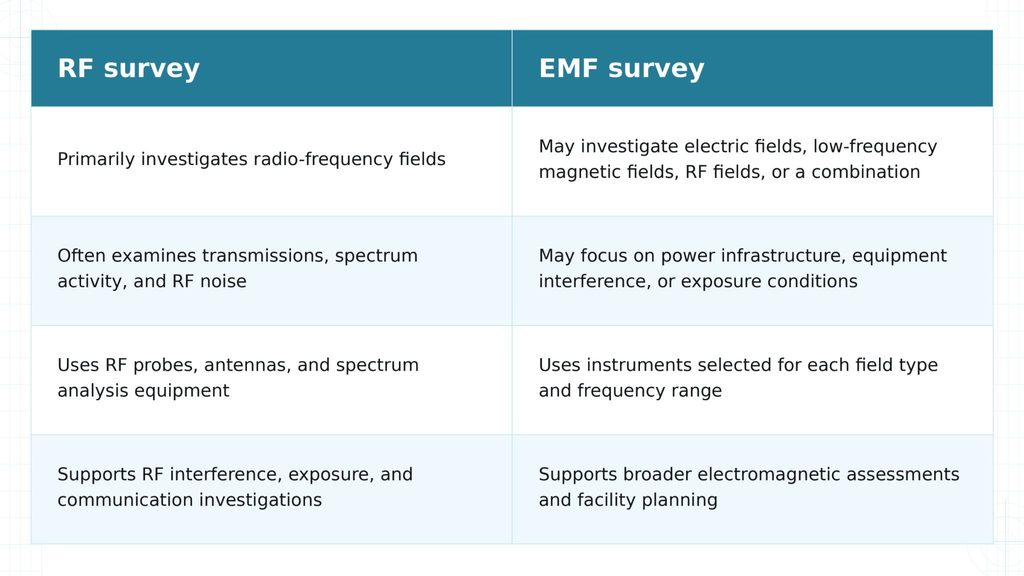
For example, unexplained signal loss in a wireless receiver may justify an RF-specific investigation.
By contrast, a laboratory located above a transformer room may require magnetic field measurement to assess low-frequency fields produced by electrical currents.
A facility experiencing several types of interference may require both.
The correct approach is determined by the suspected sources and affected equipment, not simply by the survey name.
What Happens After an RF Survey?
A completed survey should give the project team enough information to understand the measured conditions and decide whether additional investigation or corrective work is needed.
An engineering report may include measurement locations, instrument details, operating conditions, frequency spectra, field-strength readings, time-based records, suspected sources, and comparisons against applicable criteria.
The findings may point to several different solutions.
For interference involving communication systems, engineers might recommend antenna relocation, channel changes, improved cable treatment, filtering, or modifications to the source.
When external RF energy must be reduced within a particular space, RF shielded enclosures may be considered. These systems use conductive shielding boundaries and specially treated openings to limit signal transmission into or out of controlled areas.
Shielding performance depends on more than the material itself. Doors, seams, ventilation openings, cable penetrations, and installation quality can all influence the resulting attenuation.
Shielding should therefore be specified using the frequencies of concern and the reduction required at the protected equipment or space.
For projects involving several electromagnetic risks, EMF management plans can also help coordinate assessment findings, mitigation responsibilities, and verification requirements.
Once corrective work is completed, additional measurements may be needed to establish whether the intended improvement has been achieved.
When Should You Consider an RF Survey?
An RF assessment is worth considering when a facility has a defined RF concern that cannot be resolved through equipment documentation or routine troubleshooting alone.
Common situations include:
- Before Equipment Installation: Establish RF conditions before placing sensitive laboratory instruments, receivers, or imaging equipment.
- During Communication Problems: Investigate intermittent signal loss, unexplained noise, or unstable wireless operation.
- Following Facility Changes: Review conditions after installing new transmitters, wireless systems, machinery, or electronic equipment.
- For RF Exposure Documentation: Obtain the measurements needed for evaluation against applicable exposure criteria.
- Before Major Mitigation Work: Determine whether shielding, filtering, relocation, or another control addresses the actual problem.
- After Corrective Measures: Check whether changes have reduced the relevant RF signals or improved the electromagnetic conditions.
An RF survey is particularly valuable when the issue is intermittent, involves several possible sources, or affects equipment with defined electromagnetic compatibility requirements.
Make RF Measurements Part of the Engineering Decision
RF surveys help engineers distinguish between normal signal activity and electromagnetic conditions that require attention.
The findings may identify a source of unwanted emissions, establish baseline RF levels, support exposure evaluation, or show that a different investigation is needed.
The most useful results come from selecting appropriate instruments, measuring under relevant operating conditions, and interpreting the data against the requirements of the equipment or facility.
C-INTECH provides RF field measurement and interference assessment services for healthcare, research, commercial, industrial, and telecommunications environments.
If your facility is experiencing RF-related performance issues or requires a documented assessment before equipment installation, contact C-INTECH to discuss the project conditions and appropriate testing scope.
Frequently Asked Questions
1. What equipment is used during an RF survey?
Engineers may use broadband RF field meters, isotropic probes, spectrum analysers, measurement antennas, and data-logging instruments. The equipment is chosen according to the frequencies, expected signal levels, and purpose of the survey.
2. How is an RF survey different from an EMF survey?
An RF survey focuses on radio-frequency signals and emissions. An EMF survey may cover a wider range of electromagnetic conditions, including low-frequency magnetic fields from power distribution equipment and RF signals, depending on the assessment scope.
3. Can an RF survey identify the source of interference?
RF measurements can reveal unexpected signals, frequency patterns, and changes associated with suspected sources. Additional testing may be necessary to confirm that a particular emission is responsible for the interference affecting equipment.
4. When should RF measurements be repeated?
Repeat measurements may be necessary after installing new RF equipment, changing antenna configurations, modifying shielding, or introducing machinery that could alter electromagnetic conditions. Testing may also need to be repeated under different operating conditions when the reported problem is intermittent.
5. Does an elevated RF reading mean that an area is unsafe?
Not necessarily. RF exposure must be evaluated against the applicable frequency-dependent criteria, measurement procedures, and averaging requirements. A higher reading compared with surrounding areas does not, by itself, establish that an exposure limit has been exceeded.
6. Can RF shielding eliminate all interference?
No shielding system should be assumed to remove every unwanted signal. Its effectiveness depends on the frequency range, attenuation requirements, construction details, penetrations, and installation quality. Other interference paths, including conducted emissions through cables, may also require attention.
