
MRI systems depend on receiving extremely weak radio frequency (RF) signals to produce diagnostic images. When unwanted RF energy reaches the scanner’s receiving system, it can introduce noise or image artifacts that affect image quality.
This is why RF shielding is an important part of MRI room design. An MRI RF shield, sometimes called an MRI cabin or RF room, creates a controlled electromagnetic environment around the scanner by reducing the transmission of external RF signals into the imaging space.
However, an effective shielded room involves more than installing conductive materials on the walls. Doors, windows, ceilings, floors, ventilation openings, electrical connections, and service penetrations must work together as one continuous shielding system.
RF shielding must also be distinguished from magnetic shielding. RF shielding addresses radio frequency interference, while magnetic shielding is used to control static or low-frequency magnetic field conditions where required. A magnetic field analysis can help establish whether nearby electrical infrastructure also needs to be considered alongside the room’s RF shielding.
This article explains how MRI RF shielding works, the building details that influence its performance, and how project teams can coordinate installation, testing, and long-term maintenance.
Why MRI Imaging Rooms Need RF Shielding
MRI scanners use RF pulses to excite hydrogen nuclei within the body and receive signals produced as the nuclei return toward equilibrium. The receiving coils detect these weak signals, which are processed to form images.
Because the received signals are so small, unwanted RF energy entering the imaging environment can interfere with signal reception. Depending on its frequency and characteristics, interference may appear as increased background noise, lines, bands, or other image artifacts.
Understanding how EMI affects MRI performance and image quality is particularly important when investigating unexplained image degradation or planning equipment installation.
An MRI room incorporates an RF shielding enclosure to reduce the entry of external radio frequency signals. This isolation helps the scanner operate within the electromagnetic conditions specified by its manufacturer.
In healthcare and medical facilities, surrounding RF activity may originate from communication systems, wireless equipment, electronic devices, or building infrastructure.
The required shielding performance depends on several factors, including the MRI system’s operating frequency, the manufacturer’s installation requirements, the surrounding RF environment, and the project’s acceptance criteria.
There is no single RF shielding specification that should automatically be applied to every MRI installation.
How an MRI RF Shield Creates a Controlled Environment
An MRI RF enclosure works by establishing a conductive boundary around the imaging room. This boundary reduces RF energy passing between the scanner environment and surrounding spaces.
The same basic principle is used in other RF shielded enclosures, although MRI rooms have specific equipment, safety, architectural, and operational requirements.
Understanding what RF shielded enclosures are also helps explain why shielding performance depends on the complete assembly rather than the conductive material alone.
Conductive Enclosure Surfaces
MRI RF shielding systems commonly use conductive materials such as copper or steel to form the enclosure.
The shielding assembly typically extends across the walls, ceiling, and floor, creating a continuous conductive boundary around the scanner.
Panel joints, corners, floor-to-wall connections, and ceiling interfaces must maintain electrical continuity. A poorly connected seam can provide a path for RF energy even when the surrounding material has suitable shielding properties.
Material selection depends on the required attenuation, frequency range, enclosure construction, structural conditions, and installation method.
Doors, Windows, and Access Points
RF doors are among the most important components because they are opened and closed during normal operation.
A properly designed RF door uses conductive contact systems to maintain the shielding boundary when closed. Its performance depends on correct alignment, contact pressure, clean conductive surfaces, and suitable maintenance.
Over time, worn contacts, contamination, or mechanical damage can reduce shielding effectiveness.
Observation windows must also preserve the RF boundary. Shielded glazing or conductive mesh assemblies can provide visibility while limiting RF transmission through the opening.
Window frames and connections to surrounding shielding surfaces are equally important.
Mechanical, Electrical, and Data Penetrations
MRI rooms require electrical power, ventilation, medical gases, communications, monitoring systems, and other building services.
Each service crossing the RF boundary must be coordinated so that it does not create an uncontrolled opening.
Typical solutions include:
- Power filters: Limit unwanted RF energy conducted through electrical power connections.
- Signal filters: Provide appropriate RF treatment for compatible control and communication circuits.
- Waveguides: Allow certain nonconductive services or airflow to pass through specially designed openings while attenuating RF transmission.
- Ventilation penetrations: Use RF-compatible assemblies to maintain airflow without compromising the enclosure.
- Medical gas and other service penetrations: Require engineered interfaces suitable for the particular service and shielding design.
Not every service can use the same penetration method. Electrical, mechanical, equipment-vendor, and shielding requirements must be reviewed together.
Common Sources of RF Interference Around MRI Rooms
MRI facilities operate within buildings that contain numerous electronic and wireless systems. These systems do not necessarily cause interference, but some may become relevant when RF isolation is inadequate.
Common sources of RF interference include:
- Wireless communications: Cellular networks, Wi-Fi, two-way radios, and other transmitting devices.
- Electronic equipment: Displays, switching power supplies, controllers, and other devices capable of producing unwanted RF emissions.
- Building systems: Electrical and mechanical equipment containing electronic controls or switching components.
- Cables and services: Conductors crossing the shielding boundary without appropriate filtering or treatment.
- Shielding defects: Damaged seams, doors, filters, windows, or penetrations that allow external signals to enter.
The significance of any source depends on its frequency, emission level, distance, coupling path, and the MRI system’s sensitivity.
An RF source located close to the scanner does not automatically explain an imaging problem.
Investigating MRI interference may require measurements, inspection of the enclosure, and review of equipment operating conditions to identify the actual source.
Common sources of RF interference should therefore be evaluated against measured conditions rather than assumed from the presence of nearby wireless equipment.
RF Shielding vs. Magnetic Shielding in MRI Projects
Although both are electromagnetic controls, RF shielding and magnetic shielding address different technical requirements.
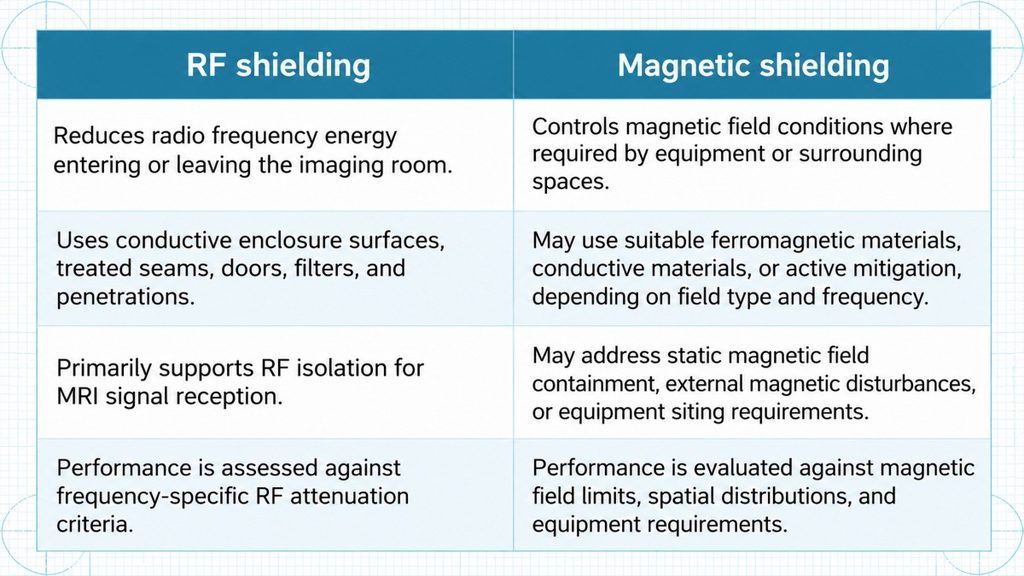
An MRI RF cabin does not automatically provide the magnetic field control required for a particular installation.
For example, magnetic shielding for MRI environments may be necessary where the scanner’s static fringe field affects adjacent spaces or where external magnetic disturbances could influence scanner operation.
The appropriate solution depends on the source and characteristics of the magnetic field.
Engineering approaches to magnetic shielding for sensitive facilities differ according to whether the concern involves static fields, low-frequency disturbances, or other magnetic conditions.
Similarly, magnetic field analysis for buildings can help determine whether shielding or other mitigation is necessary before construction decisions are finalized.
How RF Shielding Is Coordinated During MRI Room Design
RF shielding for MRI imaging rooms should be integrated into the architectural and engineering design process rather than addressed after room layouts and building services have been finalized.
Early coordination helps identify potential conflicts between the enclosure, MRI equipment, and surrounding infrastructure.
Project teams should review the MRI manufacturer’s requirements alongside room dimensions, scanner positioning, structural connections, access doors, observation windows, and equipment support areas.
Every planned service crossing the RF boundary should be identified before installation.
This includes HVAC, electrical distribution, medical gases, data connections, monitoring equipment, life-safety systems, and the interfaces associated with MRI quench arrangements.
Quench piping requires particular attention because it serves a safety-critical function and must follow the MRI manufacturer’s requirements and applicable project design criteria.
Architectural finishes, fasteners, and support systems also require coordination. Drilling through a completed enclosure or adding an unplanned cable opening can compromise RF continuity.
For this reason, RF shielded enclosures for medical facilities should be developed as part of the coordinated room design, with clear responsibility for reviewing changes that affect the shielding boundary.
Testing and Verifying MRI RF Shielding Performance
RF shielding must be tested to confirm that the completed enclosure provides the attenuation required by the MRI installation.
Shielding effectiveness is generally expressed in decibels (dB), representing the reduction in electromagnetic signal levels across the shielding boundary.
The required performance must be established from the MRI manufacturer’s specifications and project requirements. It should not be assumed that one attenuation value applies to every scanner or frequency.
Pre-Installation and Design Review
Before fabrication or installation, project teams should confirm the relevant operating frequencies, shielding performance criteria, enclosure configuration, and testing responsibilities.
The MRI manufacturer’s site planning documentation provides an important reference. For example, the Agilent MRI Systems Site Planning Guide specifies RF attenuation requirements for particular systems and addresses doors, windows, filters, and waveguide interfaces. These specifications are equipment-specific rather than universal requirements.
Reviewing drawings and penetration details before construction can identify potential leakage paths while corrections remain relatively straightforward.
Post-Installation RF Testing
Once the enclosure is installed, RF shielding effectiveness testing checks whether the complete system meets the specified performance criteria.
Testing may involve transmitting and receiving equipment positioned on opposite sides of the shielding boundary, with measurements collected at relevant frequencies and locations.
Particular attention is given to doors, seams, windows, panel connections, and service penetrations.
The IEEE 299 standard provides established measurement methods for electromagnetic shielding enclosures. The referenced IEEE 299-2006 edition is now inactive, with a replacement under development, so the applicable method and edition should be confirmed in the project specification.
Testing should identify whether performance is acceptable and, where deficiencies are found, help locate areas requiring correction.
Understanding how RF shielded enclosures prevent interference in sensitive systems also helps project teams interpret why individual weak points can affect overall attenuation.
Broader EMF testing may be necessary when the investigation includes low-frequency magnetic disturbances or other electromagnetic conditions beyond RF leakage.
When Retesting May Be Needed
Passing the original acceptance test does not mean the enclosure’s performance will remain unchanged throughout its service life.
Retesting may be appropriate after door repairs, major renovations, replacement of shielded components, installation of new service penetrations, or unexplained RF-related imaging problems.
A 2024 scientific review of RF interference in MRI documents how damaged door contacts and shielding defects can contribute to image artifacts, including cases resolved through targeted repairs.
Common RF Shielding Failure Points in MRI Rooms
Many RF shielding problems develop at interfaces rather than across the main conductive surfaces.
Facility teams should pay particular attention to the following areas:
- RF doors: Worn conductive contacts, damaged gaskets, contamination, or misalignment that prevents reliable closure.
- Panel seams: Damaged or poorly connected joints between conductive surfaces.
- Floor and wall interfaces: Deteriorated connections or damage caused by moisture, repairs, or construction activity.
- Unplanned penetrations: Holes created for new cables, fasteners, equipment, or building services.
- Filters and waveguides: Incorrectly installed, modified, or bypassed components.
- Windows and ventilation: Damaged shielded glazing, altered frames, or ventilation connections that no longer maintain the intended RF boundary.
When imaging problems occur, inspection should be supported by appropriate measurements and MRI equipment diagnostics.
Not every image artifact indicates an RF shielding defect. Scanner hardware, internal electronic noise, and other imaging-related conditions can produce similar symptoms.
Research published in RadioGraphics on MRI artifacts describes how external RF noise and inadequate room shielding can produce characteristic image disturbances.
Identifying the actual cause helps avoid unnecessary replacement of shielding materials or equipment.
Planning RF Shielding Across the MRI Project Lifecycle
RF shielding for MRI imaging rooms requires attention throughout the project lifecycle, from initial planning and installation to long-term facility operation.

For projects involving multiple electromagnetic concerns, EMF management plans can help define assessment responsibilities, coordinate mitigation requirements, and establish verification activities.
The American College of Radiology’s MR safety resources, including its 2026 safety manual, provide additional guidance on MRI facility planning and safe operation. These safety recommendations complement, rather than replace, the manufacturer’s RF shielding specifications.
Maintaining Reliable RF Shielding in MRI Facilities
RF shielding protects MRI imaging environments by reducing unwanted radio frequency energy that could interfere with scanner signal reception.
Its effectiveness depends on the entire enclosure, including conductive surfaces, doors, windows, filters, ventilation, and service penetrations. Careful coordination during design, verification after installation, and appropriate inspection following modifications are all important for maintaining the required performance.
C-INTECH provides engineering support for MRI RF shielded rooms, including shielding design and installation requirements.
For a new MRI project, facility upgrade, or suspected shielding problem, contact C-INTECH to discuss the electromagnetic conditions and appropriate engineering assessment.
Frequently Asked Questions
1. Can an existing MRI RF shield be repaired instead of replaced?
Yes. Localized repairs may be possible when leakage is traced to damaged door contacts, seams, penetrations, or individual enclosure sections. The appropriate solution depends on the shielding construction, extent of damage, and required performance. Testing after repair can confirm whether the enclosure meets the applicable criteria.
2. Can renovations in an adjacent room affect MRI RF shielding?
Yes. Renovations may affect shielding if they damage shared construction, introduce new penetrations, alter cable routes, or modify equipment near the enclosure. Work close to the shielding boundary should be reviewed before construction begins.
3. Can wireless devices be used inside an MRI RF shielded room?
Wireless equipment should only be introduced when its use is permitted under the MRI manufacturer’s requirements and the facility’s MRI safety procedures. Devices must be assessed for MR safety and electromagnetic compatibility. RF shielding does not automatically make wireless equipment suitable for operation inside the scanner room.
4. Does RF shielding also contain the MRI magnet’s static magnetic field?
No. RF shielding is designed to attenuate radio frequency energy, not to provide the required containment of the scanner’s static magnetic field. Static magnetic field control requires separate analysis and, where necessary, suitable magnetic shielding measures.
5. What should facility teams check before adding a new cable or service to an MRI room?
Any new service crossing the RF boundary should be reviewed with the shielding specialist and relevant MRI equipment team. The review should determine whether filtering, a waveguide, or another engineered penetration detail is necessary. Untreated openings can compromise shielding continuity, even when the original enclosure passed acceptance testing.
