
Electrical systems, industrial machinery, and wireless equipment generate electromagnetic fields that can be measured in different areas of a building.
Their presence is normal, but certain field conditions can interfere with sensitive equipment, affect facility planning, or require evaluation against applicable exposure guidelines.
For engineers, architects, and facility managers, the challenge is determining what electromagnetic conditions actually exist in a space and whether they are relevant to a specific project.
The presence of an electromagnetic field does not necessarily mean that equipment performance or safety is affected. Engineers need to examine the type of field, its strength, frequency, source, and the requirements of the equipment or space being assessed.
EMF Testing blog covers how engineers measure electromagnetic conditions during interference investigations, equipment installations, renovations, and shielding assessments.
The article also examines the instruments used for testing, how measurement results are interpreted, and how findings help identify potential interference sources and determine whether corrective measures are needed.
What Is EMF Testing?
Electromagnetic field (EMF) testing helps engineers understand how electric, magnetic, and radio frequency fields behave in a specific location.
Measurements are taken in areas where electrical equipment, power distribution systems, or wireless technologies may influence surrounding field conditions.
The testing approach depends on the sources being investigated. Engineers may examine magnetic fields produced by electrical currents, electric fields associated with voltage, or RF signals from communication equipment.
Professional magnetic field measurement helps determine how field levels differ across a space, change with equipment operation, or vary over time. This information can be used to investigate electromagnetic interference (EMI), establish baseline conditions, or determine whether further engineering analysis is necessary.
However, EMF testing is not a single universal procedure. Engineers select testing equipment and measurement techniques based on the electromagnetic source, its frequency, and the conditions they need to investigate.
Not all equipment responds to electromagnetic fields in the same way. MRI scanners and precision laboratory instruments, for example, may require much lower interference levels than those specified in general human exposure guidelines.
What Types of Electromagnetic Fields Are Measured?
Different electromagnetic fields require different measurement techniques. These differences help engineers choose the right testing approach and evaluate the measurements accurately.
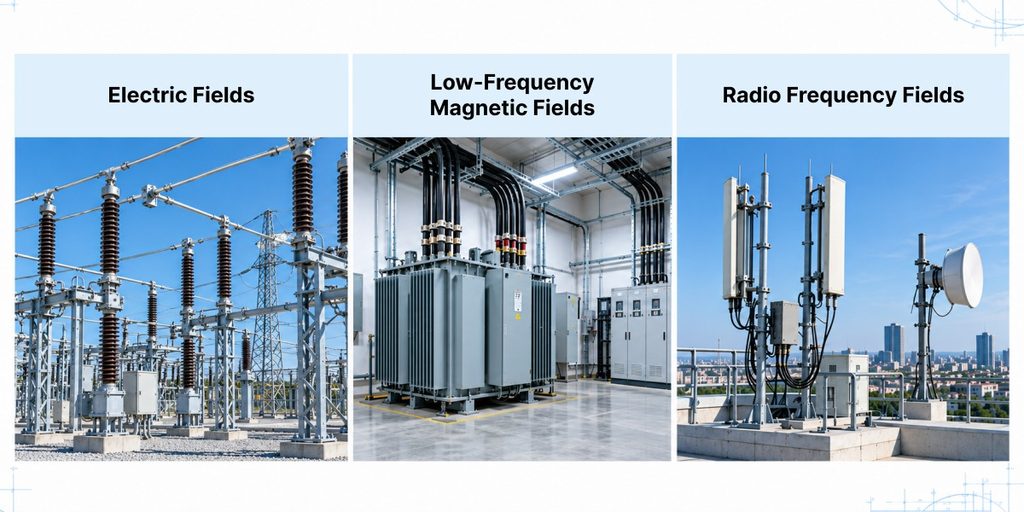
Electric Fields
Voltage creates an electric field around conductors and electrical equipment, even when no current is flowing.
Engineers measure electric field strength in volts per metre (V/m).
Measurements may be relevant near power distribution equipment, electrical installations, or other energized systems where electric field conditions require assessment.
The measurement approach depends on the frequency range, source configuration, and surrounding environment. Nearby conductive surfaces and even the position of a measurement probe can influence readings.
Low-Frequency Magnetic Fields
Electrical currents produce low-frequency magnetic fields around cables, conductors, and electrical equipment.
In buildings, these fields commonly originate from transformers, switchgear, electrical panels, bus ducts, motors, and power cables carrying high currents.
Magnetic flux density is commonly measured in:
- Microtesla (µT)
- Milligauss (mG)
One microtesla equals 10 milligauss.
Low-frequency magnetic fields can travel through common construction materials, such as drywall and concrete, without a significant reduction in field strength. For proposed electrical systems, magnetic field analysis can extend the assessment beyond current measurements by estimating conditions under future loads and layouts.
Their strength and distribution depend on current magnitude, conductor arrangement, distance, and equipment operating conditions.
For example, magnetic field readings near a transformer room may change as building electrical demand increases or decreases.
On-site measurements establish existing conditions, while magnetic field analysis can help engineers evaluate proposed electrical configurations and predict field distribution before installation.
To learn more about the effects of electrical infrastructure on surrounding spaces, read our article on magnetic field analysis for safe and compliant building design.
Radio Frequency Fields
Radio frequency fields are associated with higher-frequency electromagnetic energy generated by wireless communication systems, antennas, transmitters, and other RF equipment.
Engineers may measure RF electric field strength, assess power density, or examine signal levels at specific frequencies, depending on the testing requirements.
Depending on the instrument and application, results may be expressed in V/m, watts per square metre (W/m²), or logarithmic units such as dBµV/m.
RF assessments often examine signals at individual frequencies to help engineers distinguish between different sources and locate potential interference.
For facilities with sensitive communication equipment or controlled RF environments, radio frequency surveys help characterize signal conditions and identify potential sources requiring further investigation.
What Equipment Is Used for EMF Testing?
Instrument selection is one of the most important parts of a professional EMF assessment.
A general-purpose EMF meter cannot accurately characterize every electromagnetic field. Each instrument has defined frequency ranges, measurement capabilities, sensitivity limits, and uncertainty characteristics.
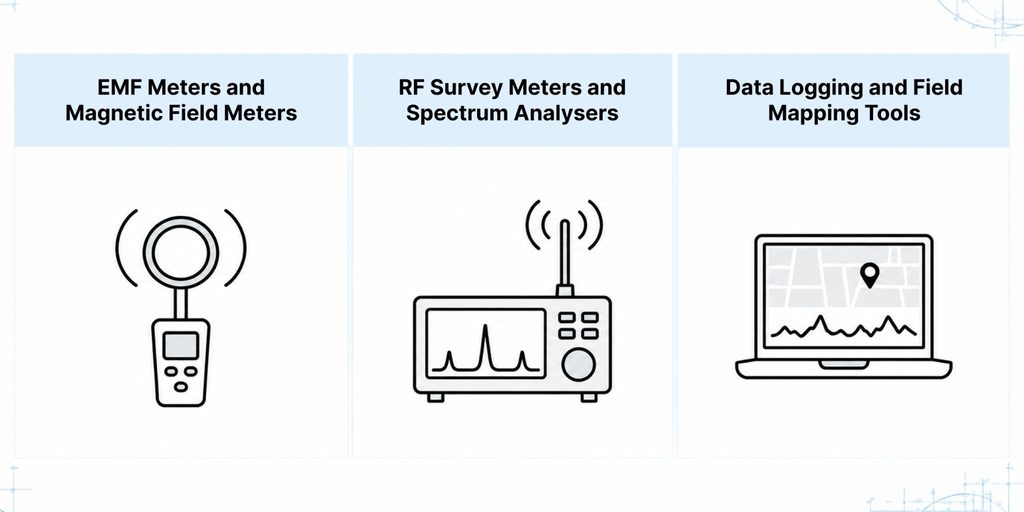
EMF Meters and Magnetic Field Meters
EMF meters are used to measure electromagnetic conditions at selected locations or along defined survey paths.
To measure low-frequency magnetic fields, engineers use calibrated gaussmeters or magnetic field meters fitted with single-axis or three-axis probes.
Three-axis meters capture magnetic field components in three perpendicular directions, helping engineers calculate the total field magnitude without repeatedly adjusting the probe’s position.
Depending on the testing objective, readings may show root mean square (RMS) magnetic flux density, field levels at particular frequencies, or changes in magnetic fields over time.
For reliable results, engineers must also consider instrument calibration, frequency response, measurement range, resolution, and correct probe placement.
RF Survey Meters and Spectrum Analysers
RF surveys use different instruments depending on the type of signals being investigated. Common options include broadband RF meters and frequency-selective equipment.
Broadband meters measure the combined RF field level across a defined frequency range. This helps engineers identify areas where more detailed testing may be needed.
Spectrum analysers examine signals at individual frequencies. With suitable antennas or probes, they can help identify active frequency bands, distinguish between RF sources, and investigate possible interference.
For example, a broadband measurement may indicate elevated RF activity in a room, while frequency-selective testing can help determine which signals contribute to that reading.
In controlled environments, such as RF-shielded enclosures, appropriate RF testing can also support investigations into shielding performance and possible leakage paths.
Data Logging and Field Mapping Tools
Electromagnetic field levels may vary during the day due to changes in electricity demand, equipment use, or activity in surrounding areas.
Data loggers track these variations over time, helping engineers detect repeated peaks and identify patterns linked to equipment operation.
Field mapping records measurements at specific points and heights throughout a building or site, showing how field strength differs between locations.
Results can be plotted on architectural drawings to identify areas with higher field levels, spatial gradients, and relationships between electromagnetic sources and sensitive equipment.
How EMF Testing Is Performed on Site
A professional electromagnetic field assessment follows a structured engineering process. The objective is not simply to collect readings but to obtain data that can answer a defined technical question.
1. Define the Testing Objective
Before measurements begin, engineers establish why testing is required.
The objective may involve investigating interference, documenting baseline conditions, assessing equipment siting, evaluating exposure, or verifying installed shielding.
This determines which field types and frequency ranges must be measured, which instruments are appropriate, and which technical criteria will be used to interpret the results.
2. Review the Site and Potential Sources
The next step is reviewing the building layout, electrical infrastructure, equipment locations, and operating conditions.
Engineers may examine electrical single-line diagrams, equipment schedules, transformer locations, feeder routes, wireless systems, and nearby external infrastructure.
This review helps identify potential sources and select meaningful measurement locations.
For example, when assessing a proposed laboratory above an electrical room, measurements should consider the locations and elevations where sensitive instruments will operate, not simply the centre of the room.
3. Take Measurements Under Representative Conditions
Measurements are collected using instruments suited to the relevant field type and frequency range.
For low-frequency magnetic fields, engineers may record readings near electrical equipment, along feeder routes, or at defined locations within occupied or sensitive spaces.
Where field conditions vary with equipment operation, measurements may be repeated during different electrical loads or operating states.
RF measurements may require frequency-selective testing, directional investigation, or repeated observations to identify intermittent signals.
A single spot measurement cannot necessarily represent the full electromagnetic environment.
For example, measurements taken during low building occupancy may not capture higher magnetic field levels associated with peak electrical demand.
4. Map, Compare, and Interpret the Results
Collected measurements are reviewed alongside floor plans, source locations, equipment operating conditions, and the criteria established for the project.
Engineers look for spatial patterns, changes over time, and relationships between field levels and suspected sources.
Results may be compared against manufacturer siting limits, project specifications, recognized exposure guidelines, or documented baseline conditions.
Importantly, an elevated reading does not automatically demonstrate that interference is occurring.
Additional measurements, source correlation, equipment performance testing, or engineering analysis may be required to establish whether the field is responsible for a particular problem.
What Can EMF Testing Reveal?
EMF testing provides evidence about electromagnetic conditions that may not be apparent from building drawings or equipment specifications.
A properly designed assessment can identify:
- Localized Field Concentrations: Areas where magnetic or RF levels are higher than surrounding locations.
- Potential Interference Sources: Electrical equipment, wireless systems, or external infrastructure associated with measured field conditions.
- Operating-Condition Changes: Differences in field levels caused by electrical loading, equipment cycles, or nearby activity.
- Sensitive Equipment Conflicts: Locations where measured conditions may exceed equipment-specific requirements.
- Mitigation Requirements: Situations where further modelling, equipment relocation, source modification, or shielding assessment may be justified.
Testing can also establish baseline conditions before construction or renovation, allowing later measurements to determine whether the electromagnetic environment has changed.
EMF Testing for Sensitive Facilities
Different facilities have different electromagnetic requirements. The assessment must consider the equipment being protected, the suspected sources, and the consequences of interference.
Healthcare and MRI Environments
Magnetic resonance imaging (MRI) systems require carefully controlled electromagnetic conditions.
Nearby transformers, electrical feeders, elevators, moving ferrous objects, and external RF sources may introduce conditions that affect MRI siting or imaging performance.
Low-frequency magnetic disturbances can contribute to image instability or artifacts under certain conditions, while unwanted RF signals may introduce noise into the received imaging signal.
These mechanisms require different investigation methods.
An MRI assessment may combine field measurements with engineering modelling to evaluate the installation environment against manufacturer requirements.
C-INTECH’s MRI interference studies address both the effect of surrounding electromagnetic sources on MRI installations and the effect of the MRI’s magnetic field on adjacent spaces.
Laboratories and Research Spaces
Research laboratories may contain electron microscopes, precision measurement systems, and other instruments that require stable electromagnetic conditions.
Electrical rooms, elevators, motors, and nearby power distribution systems can create field variations that may affect sensitive measurements.
Testing helps engineers determine whether the surrounding environment meets equipment requirements or whether additional analysis and mitigation should be considered.
Industrial, Commercial, and Data Centre Environments
Industrial and commercial facilities often contain extensive electrical infrastructure, including transformers, switchgear, uninterruptible power supplies (UPS), motors, and high-current distribution systems.
These systems can create measurable electromagnetic fields in adjacent spaces.
Data centres may also require investigations where electromagnetic conditions are suspected of affecting sensitive equipment, monitoring systems, or communication infrastructure.
The assessment should identify the specific equipment and interference mechanism rather than assuming that every measured field presents an operational risk.
How EMF Test Results Support Engineering Decisions
The value of EMF testing comes from how the findings are applied.
Measured data can help engineers determine whether an electromagnetic source is relevant to an observed problem, whether a planned equipment location is suitable, and whether mitigation is necessary.
For new construction, survey results may influence room placement, electrical routing, separation distances, and equipment selection.
For existing facilities, measurements may help identify the source of interference or establish whether operating conditions have changed following an equipment upgrade.
When field reduction is required, the appropriate solution depends on the electromagnetic source and frequency.
Possible measures include source reconfiguration, increased separation, equipment relocation, passive magnetic shielding, RF shielding, or active mitigation. For power-frequency magnetic fields, ELF field mitigation can include shielding designed around the source, affected area and required reduction.
Understanding electromagnetic shielding is useful at this stage because shielding materials and construction methods must match the field being controlled.
In more complex projects, measured results may also inform an EMF management plan, which documents field conditions, equipment criteria, mitigation decisions, and verification requirements throughout the project.
When Should EMF Testing Be Considered?
EMF testing is particularly useful when a project requires measured evidence before decisions can be made about equipment, building layouts, or interference control.
Common situations include:
- Before Sensitive Equipment Installation: To establish whether existing electromagnetic conditions are compatible with the equipment’s siting requirements.
- During Interference Investigations: When equipment exhibits unexplained noise, instability, image artifacts, or inconsistent performance.
- Before and After Shielding Installation: To establish baseline conditions and verify the effectiveness of corrective measures.
- Following Building or Electrical Upgrades: When new transformers, feeders, machinery, or wireless systems may change electromagnetic conditions.
- For Compliance and Documentation: When field measurements are required against defined exposure, equipment, or project-specific criteria.
Testing should be scheduled when the relevant equipment and source conditions can be represented accurately. Where future conditions cannot yet be measured, engineering calculations or modelling may be needed alongside the survey.
Understanding EMF Testing Results
EMF Testing Explained ultimately comes down to interpreting measurements within the correct engineering context.
A field measurement has limited value without information about its location, frequency, operating conditions, instrument characteristics, and applicable evaluation criteria.
Two locations with similar magnetic field readings may have different implications if one contains ordinary office equipment and the other houses a highly sensitive research instrument.
Likewise, a measurement taken during normal operation may not represent the highest field conditions expected during peak electrical loading.
A technically useful report should therefore explain what was measured, how the measurements were obtained, which criteria apply, and what the findings mean for the facility.
At C-INTECH, we provide engineering-led electromagnetic field surveys that support interference investigations, equipment siting, shielding decisions, and verification testing.
If your project requires electromagnetic field measurements or an assessment of potential interference sources, contact C-INTECH to discuss the appropriate testing scope.
Frequently Asked Questions
1. What does EMF testing measure?
EMF testing measures electric fields, low-frequency magnetic fields, radio frequency fields, or a defined combination. The measurements depend on the source, frequency range, equipment sensitivity, and purpose of the assessment.
2. What units are used to measure EMF?
Electric field strength is commonly expressed in volts per metre (V/m). Magnetic flux density is measured in tesla (T), often reported as microtesla (µT) or milligauss (mG). RF measurements may use V/m, W/m², dBµV/m, or other frequency-appropriate units.
3. Can one EMF meter measure everything?
No. EMF instruments operate within defined frequency ranges and have different measurement capabilities. Low-frequency magnetic fields, electric fields, and RF signals generally require different probes or instruments for reliable assessment.
4. How accurate is EMF testing?
Accuracy depends on instrument calibration, frequency response, sensitivity, probe orientation, measurement locations, operating conditions, and uncertainty. Professional testing documents these factors so results can be interpreted appropriately.
5. What happens if EMF testing finds elevated field levels?
Engineers first determine whether the measurements exceed the criteria relevant to the project. If further action is justified, recommendations may include additional testing, source modification, equipment relocation, increased separation, magnetic shielding, RF shielding, or active mitigation.
