
Ask for a price per square foot for a magnetically shielded room, and the first response may be a request for drawings. Architectural magnetic shielding cost depends less on room size alone than on the magnetic field being controlled and the result the project needs.
Five factors shape the budget: the source and its frequency, the required field reduction, the space being protected, the installation conditions, and the engineering needed to design and verify the work. They help architects and project managers compare quotations.
Why There Is No Universal Price for Architectural Magnetic Shielding
Two rooms with the same floor area can require very different shielding. An office above a transformer room and a research laboratory beside high-current feeders may face different field patterns, operating loads, and equipment requirements. Neither layout gives a reliable price.
Magnetic shielding cost factors include:
- Source and frequency: Transformers, bus ducts, electrical risers and nearby transit infrastructure produce different magnetic field conditions. Power-frequency sources call for different design considerations than static fields or radio frequency (RF) interference.
- Required reduction: A small adjustment in field level and a substantial reduction across a sensitive instrument zone are different engineering problems.
- Protected space: A localised equipment area, one wall or an entire room changes the amount and arrangement of shielding.
- Site conditions: New construction, occupied premises and restricted electrical rooms bring different access, labour and sequencing requirements.
- Verification: Field measurements, modelling and acceptance testing can be separate items in a quotation.
Material prices cannot account for these variables. A useful estimate needs a design basis.
Start with the Field Conditions and Performance Target
The starting point is the field expected at the protected location and the field condition required there. For existing buildings, measurements establish a baseline under the operating loads present during the survey. Peak demand or later upgrades may produce different conditions.
For unbuilt spaces, Magnetic field analysis can use electrical drawings, source information, and finite element analysis (FEA) to estimate future conditions. Modelling can also compare alternatives such as moving sensitive equipment, changing feeder routes or reducing the extent of shielding before materials are ordered.
Record source locations, loads, frequencies, measurement positions and applicable equipment criteria.
How Materials and Shield Geometry Affect the Budget
Materials are among the largest magnetic shielding cost factors, but different metals are not interchangeable. High-permeability materials can provide a preferred path for magnetic flux, while conductive layers can oppose changing magnetic fields through induced currents. The effect depends on frequency, field strength, and geometry.
Thickness, layers, and coverage affect weight and fabrication. High-permeability materials also have limits: as magnetic flux density increases, some designs can approach saturation and lose effectiveness. More layers do not automatically deliver a proportional improvement. Engineers must assess the complete configuration, including joints and surrounding construction.
The principles of how magnetic shielding works in sensitive facilities explain why shield placement and shape can matter as much as the material selected.
Material Selection and Fabrication
A sheet-metal price does not capture the cost of a finished shielding assembly. Panels may require controlled cutting, forming, joining, support details, and protection during transport. Some high-permeability nickel-iron alloys are sensitive to mechanical stress and may need treatment after fabrication to achieve specified properties. Confirm this requirement for the specific alloy; it does not apply to every shield.
Two quotations labelled “magnetic shielding steel” may specify different grades, thicknesses, layer arrangements and fabrication methods. Ask bidders to identify what they have actually included.
Room Coverage and Openings
Not every project needs a fully enclosed shielded room. Depending on the source and target, ELF magnetic shielding may cover a wall, floor, ceiling, or selected equipment zone. Partial coverage can reduce material quantities, but fields can redistribute around edges. The necessary extent should be established by engineering analysis rather than a standard overlap distance.
Joints, corners, doors, ducts, conduits, and cable trays also influence the assembly. Each opening or interface may require a coordinated detail, and the relevant treatment differs from an RF enclosure, where electrical continuity is often central. That distinction is explained in C-INTECH’s article on electromagnetic shielding in buildings. Confirm covered surfaces and penetrations before pricing.
Installation, Access and Design Coordination
In new construction, shielding can be coordinated with architectural and building-service assemblies. In a retrofit, the same materials may require opening finished surfaces, protecting occupied areas, relocating services, or scheduling work around operating equipment.
Key budget considerations include:
- Access: Limited working space, restricted electrical rooms, and shutdown requirements can alter installation sequencing.
- Finishes: Removal, protection, and reinstatement of flooring, ceilings, or wall finishes may sit outside the shield supplier’s price.
- Structural loads: Multi-layer assemblies can add weight that needs review, especially for ceilings and suspended supports.
- MEP coordination: Ducts, pipes, conduits and other services crossing a shielded surface require agreed details.
- Programme: Fabrication, delivery and installation must fit the work of other trades and any occupied-building restrictions.
Considering magnetic field analysis during building design can preserve options to move equipment, revise routes or reserve assembly depth before those changes become disruptive.
Allow for Engineering and Performance Verification
Material supply and installation are only part of a complete scope. A quotation may need to distinguish five activities:
- Investigation: Review of electrical sources, loads, existing measurements and equipment criteria.
- Design: Selection of shielding materials, geometry, coverage and construction details.
- Modelling: Evaluation of predicted field conditions and proposed mitigation options.
- Installation: Fabrication, delivery and fitting of the approved assembly.
- Acceptance measurements: Testing after installation at agreed locations and operating conditions.
If electrical loads during acceptance testing differ from design assumptions, agree how results will be interpreted. Define test locations, equipment states, and corrective-work responsibilities in advance.
C-INTECH’s ELF field mitigation service addresses assessment, engineered shielding, installation, and performance verification for applicable low-frequency field conditions.
How to Compare Shielding Quotations
The cheapest total is not necessarily the most complete quotation. To make bids comparable, ask each contractor to identify the following:
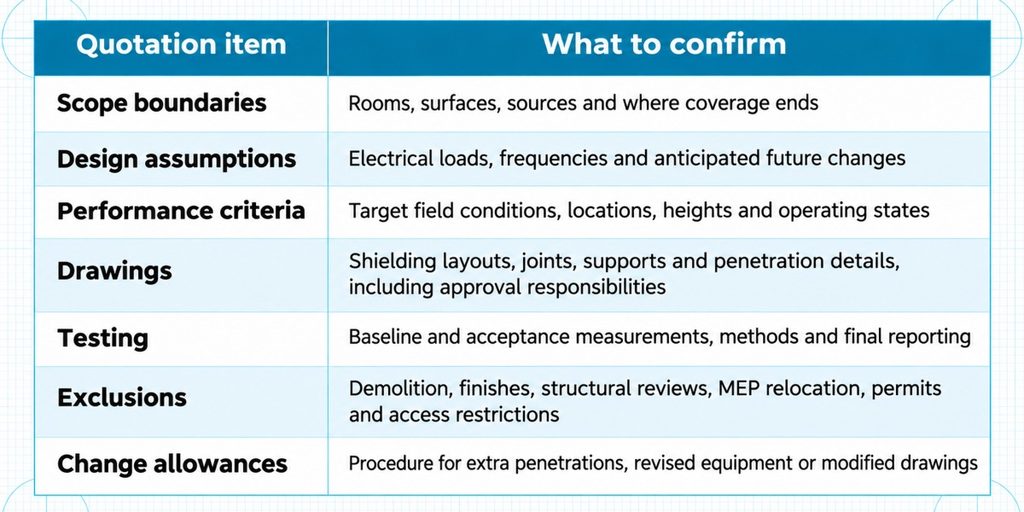
A clear quotation exposes different performance assumptions and excluded work before construction starts.
Discuss Your Shielding Scope with C-INTECH
A useful estimate starts with a defined source, performance target, and protected area.
C-INTECH provides magnetic field assessment, FEA-based design, architectural shielding, and verification support for sensitive spaces. If you are planning a laboratory, imaging suite, or occupied area near major electrical infrastructure, contact C-INTECH with available plans, source information, equipment criteria, and project objectives to discuss an appropriate scope.
Frequently Asked Questions
1. Can architectural magnetic shielding be treated as a standard tenant improvement?
Not automatically. Because shielding may become part of walls, floors, or ceilings, the lease and project agreements should establish who pays for it, who owns it, and whether it must be removed at the end of the tenancy. Landlord or tenant responsibility cannot be assumed.
2. Can existing shielding be salvaged when a room is refurbished?
Possibly. Individual panels may be reusable, but removal, bending, damage, or changes to the room layout can affect the installed system. Allow for inspection, a design review against the new requirements, and acceptance measurements after reinstallation.
3. What happens to the estimate if the equipment supplier changes mid-project?
Review the new supplier’s siting requirements, equipment position, and sensitivity against the original design basis. The existing design may remain suitable, or it may need changes to coverage, material selection, or verification. Record the decision before proceeding.
4. Should a quote distinguish a performance warranty from a material warranty?
Yes. A material warranty and a promise to achieve defined field conditions address different matters. Any contractual warranty should specify its scope, duration, exclusions, measurement conditions, and remedies. Do not assume either type of coverage is included.
5. Can shielding requirements affect usable floor area?
Yes. Wall assemblies may become thicker, floors or ceilings may need additional build-up, and some details require access space. Actual space loss depends on the approved configuration, so the architect should confirm dimensions before layouts are fixed.
6. Can shielding costs be shared between multiple future tenants?
Shared procurement may be possible, but future tenants may have different equipment, siting criteria, and occupancy needs. A cost-sharing arrangement should separate common infrastructure from tenant-specific requirements and assign design, testing, maintenance, and contractual responsibilities.
