
The survey report shows low magnetic field readings beside the electrical room, and the design team relaxes. Then someone asks what the building was doing at 10:40 that morning, and nobody knows. The chiller might have been off, the production line idle, or the elevator parked on another floor.
Operating conditions matter during an electromagnetic field (EMF) survey because most magnetic fields in buildings exist only while current flows, and they change as loads change. A reading without its operating context can’t tell you whether a space is typical, unusually quiet, or near its busiest state.
This guide explains which conditions change results, how to plan representative measurement scenarios with the facility team, and what a report should say about the states it did and didn’t capture.
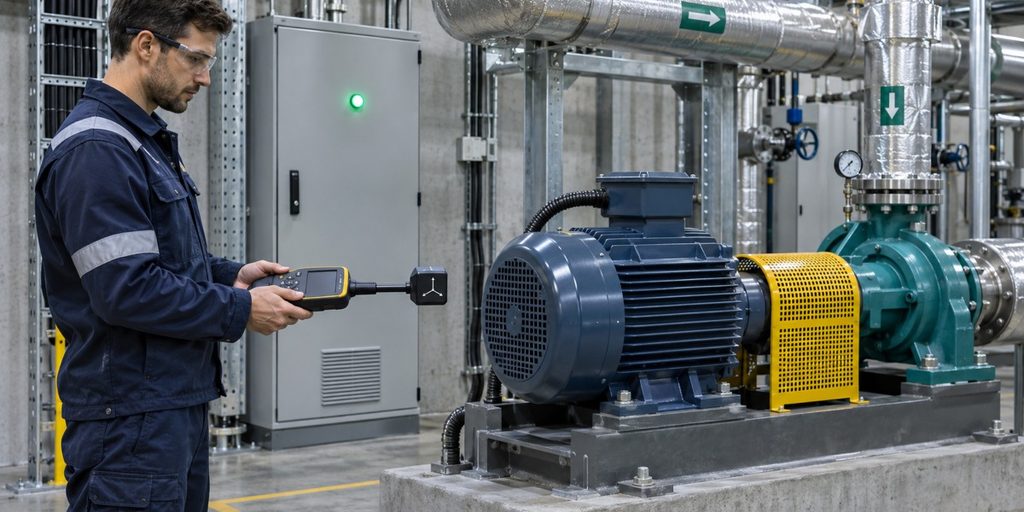
An EMF Reading Describes a Particular Operating State
Every reading is a snapshot of one location at one moment, under whatever the building happened to be doing. The same spot can read very differently an hour later. EMF surveys are most useful when each reading carries that context with it.
A timestamp on its own doesn’t provide that context. It records when a value was taken, not which feeders were loaded, which drives were running, or whether a large motor had just started. Without those details, a later reader can’t tell a quiet period from a genuinely quiet space. Understanding what an EMF survey measures makes it clear why the operating state belongs in the record next to the number.
Which Equipment Conditions Can Change the Result?
Equipment load drives most magnetic field measurements, but it doesn’t affect every source the same way. A magnetic field is present only when there is current, and its strength tracks how much power the equipment is drawing. Beyond that basic link, several conditions shape the result:
- Current: Higher current in feeders, busways, and transformers generally means a stronger field nearby.
- Duty Cycles: Equipment that runs in on-off cycles, such as compressors and pumps, produces its field only part of the time.
- Switching: Motor starts and circuit switching can cause short-lived changes that a brief visit may miss.
- Harmonics: Electronic loads add field components at multiples of the power frequency. The international measurement standard notes that converters can also create alternating current (A.C.) harmonic components that should be assessed.
- Variable-Speed Drives: Motors on variable-frequency drives change speed and current with demand, so fields shift as the process changes.
- Simultaneous Sources: Several circuits running at once can add together or partly cancel, depending on their routing and phase arrangement.
Because each source responds differently, one “building on” reading can’t describe all of them. A transformer may be near peak while a nearby drive is idling, and the reverse may be true an hour later.
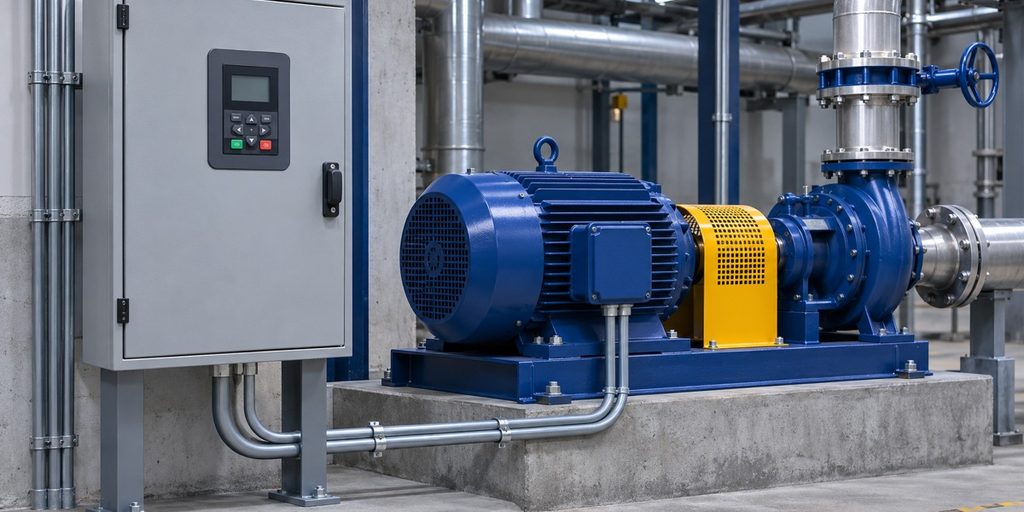
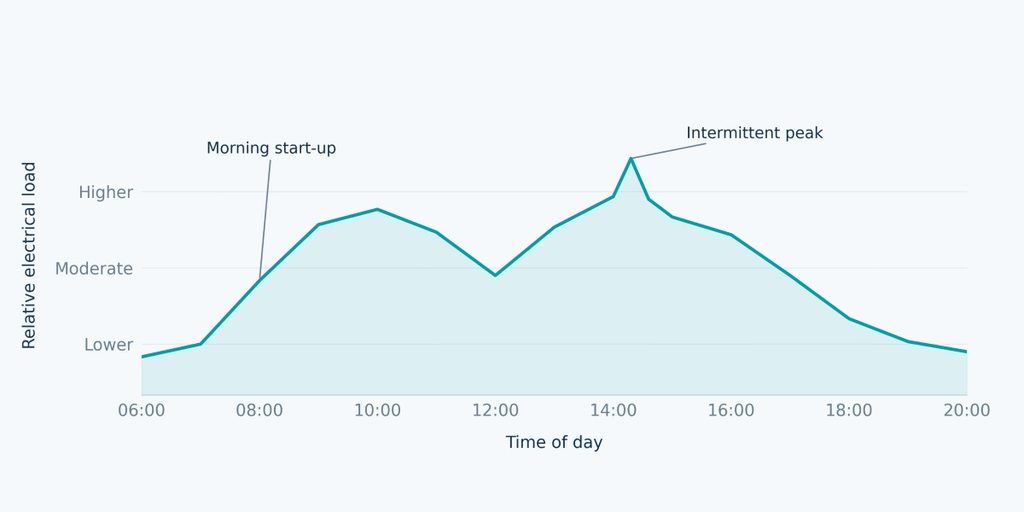
Changing Loads and Intermittent Processes
Few facilities sit at one steady load. Some common patterns:
- Cycling Plant: Chillers, air handlers, and pumps stage on and off with temperature and occupancy, so a mechanical room can go from quiet to busy within minutes.
- Production Shifts: Manufacturing lines, labs, and server loads often ramp up during the day shift and drop overnight or on weekends.
- Batch Processes: Ovens, presses, and test rigs may draw heavy current for short periods and sit idle in between.
- Seasonal Loads: Heating and cooling equipment works hardest at different times of year, so a January survey may not reflect July.
A survey scheduled without asking about these patterns can capture an unusually quiet hour and present it as normal. Ten minutes of questions with the operations team before fieldwork usually prevents that.
Moving Equipment and Nearby Activity
Not every change comes from an electrical load. Moving objects can disturb the magnetic environment in a different way:
- Elevators: The motor and drive produce fields while the car runs, and the steel car and counterweight shift position along the shaft.
- Vehicle Traffic: Cars, trucks, and buses in nearby parking areas or loading docks move large steel masses past the building.
- Other Moving Ferromagnetic Objects: Carts, beds, forklifts, and equipment moved through corridors can distort the field around them.
These effects behave differently from a fixed electrical load. A moving steel mass mainly disturbs the static, or direct current (D.C.), field rather than producing a power-frequency field of its own, and it matters most near equipment sensitive to small static changes. Magnetic resonance imaging (MRI) siting documents, for example, set separation distances for moving metal such as cars, vans, and buses.
Plan Representative Measurement Scenarios
The facility team knows when the building is busy, quiet, and changing. Before fieldwork, agree on which states the survey should capture:
- Typical Conditions: Normal occupancy and production, representing most of the operating time.
- High-Load Conditions: The busiest regular period that can be safely observed, such as peak production or full cooling demand.
- Relevant Transients: Short events that matter for the question being asked, such as motor starts, elevator runs, or batch cycles.
Be clear about what each state is. An observed high-load period is a measurement; an assumed maximum, a nameplate rating, or a design load is something else, and the report should label it that way. A short site visit, however well timed, captures the conditions present during that visit, so it shouldn’t be described as a proven worst-case survey.
Record Operations Alongside Field Measurements
Readings become interpretable when EMF monitoring conditions are recorded right next to them. Useful records include:
- Synchronized Timestamps: Instrument clocks checked against the building’s own systems, so events can be matched reliably.
- Equipment States: Which systems were running, idle, or off, including modes and setpoints where relevant.
- Available Load Records: Building management system (BMS) trends, power meter data, or production logs covering the survey period.
- Instrument Settings: Frequency band, sampling interval, and any filtering applied.
- Measurement Locations: Each point marked on a plan, with its height above the floor.
Utility measurement protocols already expect the current flowing in equipment and the date and time to be logged with each result, and the same logic works inside buildings.
Logging duration should follow the question and the operating cycle. A spot check can confirm a steady condition, but a process that cycles every few hours or varies across shifts needs logging long enough to cover the full cycle, sometimes over several days.
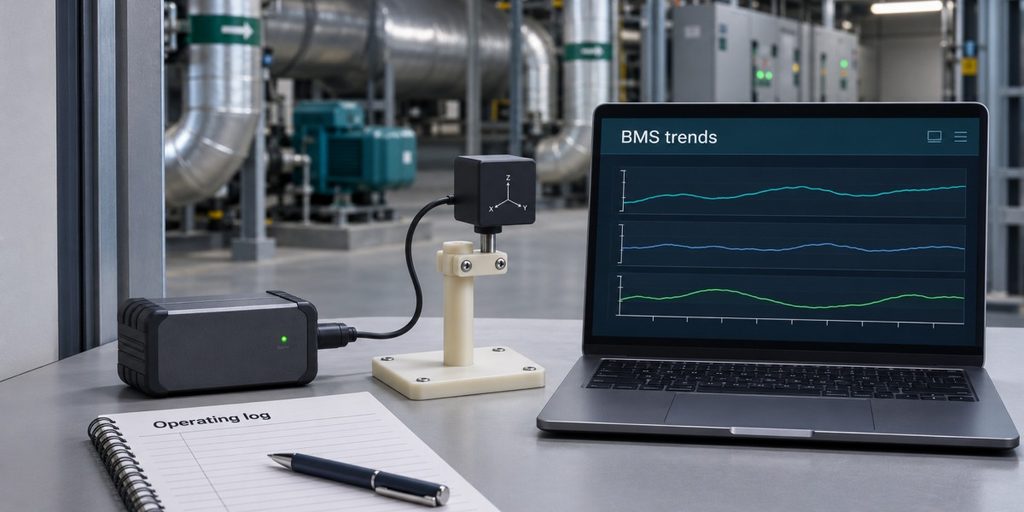
What to Do When Full Operation Cannot Be Observed
Sometimes the conditions that matter aren’t available during a visit. A plant may be down for maintenance, a new building may not be occupied yet, or equipment may be too critical to cycle for a test. When that happens:
- Document the Restrictions: Record which systems were unavailable and why.
- Arrange Follow-Up: Where the gap matters, schedule further measurements for when the relevant equipment is running.
- Use Analysis for Justified Scenarios: Magnetic field analysis can estimate fields for defined loads using conductor geometry and documented assumptions.
Avoid scaling every result linearly from one load reading. The field near a single circuit may track its own current, but several sources, phase balance, and currents on unintended return paths don’t change in step, so doubling one load rarely doubles every reading. Modelling within magnetic field analysis in engineering projects keeps those assumptions visible instead of hiding them inside a multiplier.
Report Findings with Their Conditions and Limits
A useful report says which conditions each finding applies to. The simplest way is a scenario matrix: a table listing each operating state against each location, marked as measured, modelled, or not assessed. A short example:
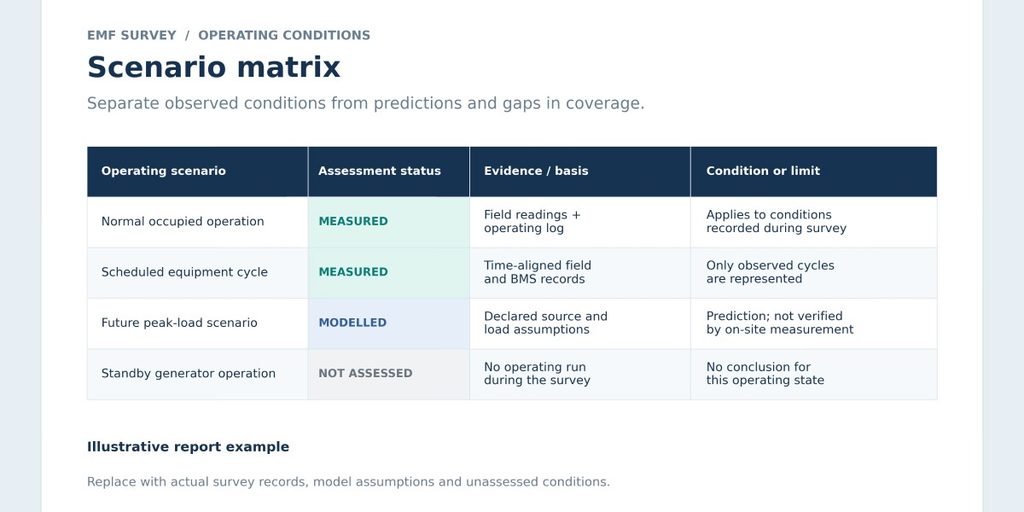
That table prevents a common mistake: reading a typical-load result as if it covered peak operation or future equipment. It also shows the design team exactly where uncertainty remains.
When operations will keep changing through new equipment, process changes, or occupancy shifts, EMF management plans track those changes and set out when to measure again. Each significant change becomes a trigger for review. That approach supports EMF management throughout building operation, rather than treating one survey as the final word.
Coordinate EMF Survey Operating Conditions with Facility Operations
The most useful surveys are planned with the people who run the building. Before fieldwork, work through a short checklist with the facility team:
- Define the Question: Agree on what the survey must answer, such as siting sensitive equipment, investigating a complaint, or verifying a change.
- Map the Operating Cycle: Identify typical, high-load, and transient conditions, and when each one happens.
- Confirm What Can Be Observed: List the systems that can’t be run or changed during the visit.
- Share Records: Arrange access to BMS trends, meter data, and production logs, with clock offsets checked.
- Keep Operations Safe: The survey should never require unsafe switching or unauthorized shutdowns. Any equipment changes are made by authorized staff under the facility’s own procedures.
- Agree on the Report Format: Ask for the scenario matrix and clear labels for measured, modelled, and not assessed conditions.
With that groundwork, the results describe the building as it actually runs, and the decision that follows rests on evidence instead of one lucky hour. If you’re planning a survey and want help defining representative operating states, contact C-INTECH to talk it through.
Frequently Asked Questions
1. Should survey instruments share a clock with the building-management system?
Ideally, or at least the offset between them should be known. Before correlating records, check clock offsets, time zones, and each system’s timestamp resolution; a meter logging every second and a trend log recording every 15 minutes can’t be matched event by event.
2. Can a change from daylight saving time create misleading event matches?
Yes. When clocks fall back, an hour of local timestamps repeats, and when they spring forward, an hour goes missing, so records can appear to line up when they don’t. State whether each dataset uses local time or Coordinated Universal Time (UTC), and convert everything to one convention before comparing.
3. Do clamp-meter current readings always explain the measured magnetic field?
No. A clamp meter shows current in one conductor or group, but the field also depends on conductor spacing, phase arrangement, return paths, and other nearby sources. Two circuits carrying the same current can produce very different fields, so current readings support the interpretation rather than replace it.
4. Can equipment be electrically off but still influence the magnetic environment?
Yes. A de-energized machine with a large steel frame can still distort the static magnetic field around it, and a superconducting MRI magnet keeps its strong static field even when it isn’t scanning. Switching equipment off removes only the field caused by current flowing through it.
5. Can equipment self-tests be mistaken for normal production cycles?
They can. Diagnostic and start-up routines may energize different components, or the same components at different levels, than normal production does. Ask operators when self-tests run, and label those periods separately when reviewing an event.
6. Should a process recipe change be recorded even if the equipment name is unchanged?
Yes. A different recipe, mode, or sequence can change which motors, heaters, or drives run and how hard, and that changes the fields they produce. Record the recipe or mode alongside the equipment name, because the name alone doesn’t describe what the machine was doing.
