
Medical imaging departments combine sensitive diagnostic equipment with electrical infrastructure, mechanical systems, and wireless technologies. When imaging rooms are located near electrical rooms, elevators, or high-current feeders, electromagnetic interference (EMI) may become a concern.
For healthcare planners and engineers assessing electromagnetic interference in medical imaging, the priority is determining whether surrounding electromagnetic sources could affect equipment performance, signal stability, or manufacturer-defined operating requirements.
MRI systems are particularly sensitive to magnetic and radio-frequency (RF) disturbances, while other imaging technologies have different requirements. This article explains how EMI risks develop, how engineers assess them, and how building design can help control interference.
What Electromagnetic Interference Means in Medical Imaging
Electromagnetic interference occurs when unwanted electromagnetic energy disrupts or degrades the intended operation of electrical or electronic equipment.
In medical imaging environments, the concern is not simply whether electromagnetic fields are present. It is whether those fields, or disturbances conducted through connected systems, interfere with equipment operation or exceed defined performance requirements.
Understanding electromagnetic interference in medical imaging requires examining several factors, including the source of the disturbance, its frequency, how it reaches equipment, and the equipment’s susceptibility:
- Field type and frequency: Low-frequency magnetic disturbances and RF interference affect equipment differently.
- Source characteristics: Current magnitude, operating frequency, physical arrangement, and changes in electrical load influence the disturbance.
- Distance and coupling path: Electromagnetic energy may reach equipment through space, cables, or other conductive connections.
- Equipment sensitivity: Different imaging systems have different susceptibility characteristics.
- Operating conditions: Some disturbances occur only when nearby equipment starts, stops, or changes operating state.
These considerations also explain the distinction between EMI and electromagnetic compatibility (EMC). EMI describes unwanted interference, while EMC describes equipment’s ability to operate acceptably within its electromagnetic environment without causing unacceptable disturbances to other equipment.
The U.S. Food and Drug Administration’s guidance on electromagnetic compatibility of medical devices provides recommendations for evaluating medical device emissions and immunity.
However, product-level EMC testing does not eliminate the need to evaluate actual conditions at a proposed installation site.
Electromagnetic Considerations for Different Medical Imaging Systems
Medical imaging electromagnetic interference risks vary between MRI, CT, digital X-ray, and ultrasound systems because each technology operates differently and has its own electromagnetic compatibility requirements. These differences influence how engineers assess potential interference.
MRI Systems
Magnetic resonance imaging (MRI) requires a carefully controlled magnetic and RF environment.
MRI scanners use a strong static magnetic field, controlled gradient fields, and RF signals to acquire imaging data. External magnetic disturbances or unwanted RF energy can affect image acquisition under certain conditions.
Electrical distribution equipment, nearby moving ferromagnetic objects, and discontinuities in RF shielding may therefore require investigation during MRI planning.
For example, an MRI suite proposed next to an electrical riser may need a magnetic field assessment to establish whether the feeder’s expected operating current could create unacceptable field variations at the scanner. For example, an MRI suite proposed next to an electrical riser may need magnetic field analysis to establish whether the feeder’s expected operating current could create unacceptable field variations at the scanner.
CT and Digital X-Ray Systems
Computed tomography (CT) and digital X-ray equipment use different imaging mechanisms from MRI. They do not depend on the same controlled magnetic environment for image acquisition.
However, these systems incorporate electronic detectors, power supplies, communication interfaces, control circuits, and data acquisition equipment that must operate reliably.
Electromagnetic compatibility considerations may include conducted disturbances, RF emissions, power quality, and interference affecting electronic subsystems.
The relevant requirements depend on the equipment model, manufacturer specifications, and applicable standards. It would be incorrect to assume that CT or X-ray systems need the same magnetic shielding or RF enclosures as MRI scanners.
Ultrasound and Other Electronic Imaging Equipment
Ultrasound systems use acoustic waves for imaging, but their operation also depends on sensitive electronic circuits that generate, receive, and process signals.
Depending on the system and interference mechanism, electromagnetic disturbances may affect electronic signal processing or equipment behaviour.
This does not mean that ultrasound equipment is inherently sensitive to the same external magnetic conditions as MRI.
The practical approach is to review the specific equipment’s EMC documentation and investigate only those electromagnetic conditions that could reasonably affect its operation.
For healthcare and medical facilities, these differences make equipment-specific planning essential, particularly when multiple imaging technologies share the same building infrastructure.
Common Sources of Electromagnetic Interference in Healthcare Facilities
Electromagnetic interference in medical imaging facilities may originate from electrical distribution systems, RF equipment, moving metallic objects, or other infrastructure located inside or outside the building.
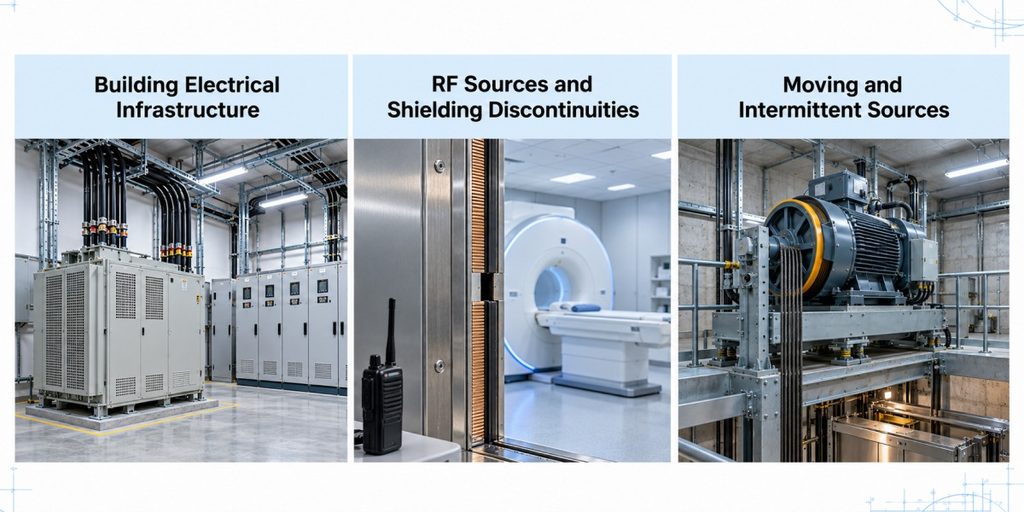
Building Electrical Infrastructure
Transformers, switchgear, bus ducts, electrical panels, high-current feeders, backup power systems, and large mechanical loads can produce electromagnetic fields.
For low-frequency magnetic fields, the strength reaching an imaging room depends on current, conductor geometry, separation distance, and operating conditions.
For instance, when the electrical load varies during the day, a feeder above an imaging department may produce varying magnetic field levels.
This is why magnetic field analysis for safe building design should consider both equipment placement and expected operating conditions.
RF Sources and Shielding Discontinuities
Wireless infrastructure, communications equipment, electronic devices, and other RF sources can introduce electromagnetic energy into sensitive environments.
For MRI rooms, the RF shielding enclosure helps reduce unwanted external signals. However, the enclosure’s performance depends on conductive continuity across its walls, doors, seams, ventilation interfaces, filters, and service penetrations.
A damaged door contact or improperly treated penetration may reduce shielding effectiveness.
A 2024 study published in the Journal of Clinical Imaging Science describes how unwanted RF energy inside an MRI scanner room can produce characteristic interference artifacts and identifies compromised shielding and equipment within the room as potential causes.
Moving and Intermittent Sources
Elevators, moving ferromagnetic equipment, vehicles, construction activity, and changing electrical loads can introduce disturbances that vary over time.
These conditions are particularly relevant to MRI installations, where nearby moving ferromagnetic objects may disturb the magnetic environment.
An assessment conducted while an elevator is stationary or an electrical load is inactive may not capture the conditions of concern.
Representative operating conditions should therefore be considered when planning field measurements.
How Building Design Influences EMI Risks in Imaging Departments
Managing EMI risks in medical imaging environments begins with coordinated equipment placement, electrical distribution planning, and early review of manufacturer siting requirements. Addressing these considerations before layouts are finalized gives project teams more flexibility to reduce potential interference.
Room Adjacency and Equipment Placement
An imaging room’s location relative to electrical and mechanical infrastructure can influence the electromagnetic conditions it experiences.
Project teams should examine not only adjacent rooms, but also the spaces above and below the proposed installation.
A transformer room on the floor below an MRI suite, for example, may be more relevant to the assessment than an electrical panel farther away on the same level.
Distance alone does not determine suitability. Field direction, source geometry, conductor arrangement, and equipment-specific requirements must also be considered.
Electrical Distribution and Cable Routing
Electrical feeder routes are sometimes finalized after major architectural decisions have been made.
In sensitive facilities, this can create coordination problems when high-current cables or bus ducts are routed close to imaging equipment.
Where practical, design teams may reduce magnetic field exposure by adjusting cable routes, maintaining suitable separation, or reviewing conductor arrangements.
These changes should be evaluated through engineering analysis rather than relying on general assumptions about safe distances.
Shared Infrastructure and Future Expansion
Hospitals frequently renovate departments, replace imaging equipment, increase electrical capacity, or install new communication systems.
A room that meets the original scanner’s requirements may need reassessment when equipment changes.
Similarly, a new electrical riser or mechanical installation could alter the electromagnetic environment around an existing imaging suite.
Documenting existing field conditions and equipment criteria provides a useful basis for reviewing future changes.
How EM Interference Can Affect Imaging Performance
Electromagnetic interference in medical imaging can affect signal stability, electronic equipment operation, or image acquisition, depending on the imaging technology and disturbance involved. Potential effects include increased electronic noise, communication problems, and difficulties meeting installation or commissioning criteria.
In MRI environments, external RF signals can interfere with the scanner’s receiving system, while certain magnetic field variations can influence image acquisition.
One recognized example is the MRI zipper artifact, which can appear as lines or bands in an image when unwanted RF energy reaches the receiving system.
The peer-reviewed article Body MR Imaging: Artifacts, k-Space, and Solutions examines MRI artifacts, including those associated with RF interference and magnetic field imperfections.
However, image abnormalities do not automatically indicate EMI. Patient motion, acquisition settings, scanner hardware, and other technical factors can also produce artifacts.
The engineering investigation should establish whether an electromagnetic disturbance is present and whether it corresponds with the reported equipment behaviour.
Interference can also affect project delivery. If a completed imaging room does not meet the specified environmental requirements, additional investigation or corrective work may be necessary before equipment acceptance.
How Engineers Assess Electromagnetic Interference in Medical Imaging Facilities
A medical imaging EMI assessment combines equipment specifications, electromagnetic field measurements, source identification, and engineering modelling to determine whether interference risks exist and whether corrective measures are necessary.
Review Equipment and Project Requirements
The first step is to identify the equipment being installed and its relevant electromagnetic operating criteria.
Engineers examine surrounding electrical infrastructure, room layouts, manufacturer data, and other possible sources.
The assessment should establish which interference mechanisms require evaluation rather than automatically prescribing the same testing for every imaging system.
Conduct On-Site EMF and RF Measurements
Existing electromagnetic conditions can be evaluated through targeted field measurements.
Depending on the project, these may include low-frequency magnetic field measurements, RF measurements, and monitoring of suspected intermittent sources.
Measurements should cover relevant locations and operating conditions, including adjacent electrical rooms, feeder routes, and potential equipment installation areas.
A professional EMF survey helps document existing conditions and determine whether further investigation or mitigation is justified.
Use Magnetic Field Modelling During Design
When proposed electrical infrastructure has not yet been installed, measured conditions cannot fully represent the future environment.
Finite element analysis (FEA) and other engineering modelling methods can estimate magnetic field distributions based on the proposed electrical and physical arrangement.
The results can be used to compare equipment locations, conductor configurations, separation distances, and shielding concepts.
C-INTECH’s MRI EMF interference studies support imaging projects requiring magnetic field assessment, modelling, and review against equipment-specific siting conditions.
Compare Results With Manufacturer Criteria
There is no universal EMI threshold that applies to every medical imaging system.
Measured and modelled conditions should be evaluated against the appropriate manufacturer specifications and other applicable project requirements.
The findings should identify whether conditions are acceptable, whether further investigation is required, or whether specific mitigation measures should be considered.
Controlling EM Interference in Medical Imaging Environments
Reducing electromagnetic interference in medical imaging environments may involve source control, increased separation, revised electrical routing, RF shielding, magnetic shielding, or active mitigation. The appropriate solution should be selected only after the source, frequency range, coupling path, and affected equipment have been evaluated.
Source Control and Space Planning
Where practical, interference can sometimes be reduced without installing shielding.
Possible measures include relocating electrical equipment, increasing separation, adjusting cable or bus-duct routing, and modifying room adjacency.
These options are generally easier to coordinate during design than after imaging equipment has been installed.
Magnetic Shielding and Active Mitigation
Passive magnetic shielding may be considered where equipment relocation or source control cannot provide the required field conditions.
Shielding effectiveness depends on material properties, geometry, field frequency, field direction, and potential magnetic saturation.
The principles of magnetic shielding for sensitive facilities are particularly relevant where sensitive imaging equipment is located near substantial electrical infrastructure.
Active mitigation may also be appropriate for certain variable, low-frequency magnetic disturbances. These systems use sensors, controllers, and compensation coils to reduce selected field variations within a defined area.
Neither approach should be specified without assessing the actual interference mechanism and required performance.
RF Shielding and Controlled Enclosures
MRI suites typically incorporate RF-shielded enclosures that reduce unwanted radio-frequency energy entering the scanning environment.
Continuity between walls, ceilings, floors, doors, ventilation openings, filters, and service penetrations is essential for effective shielding.
The engineering principles behind RF shielded enclosures explain why the complete shielding boundary must be evaluated rather than individual surfaces alone.
Importantly, an MRI RF enclosure does not automatically address low-frequency magnetic interference from nearby electrical infrastructure.
When Should EMI Be Evaluated in a Medical Imaging Project?
An electromagnetic interference medical imaging assessment is most valuable during early project planning, when engineers can still coordinate equipment locations, electrical infrastructure, and potential mitigation measures before construction.
- Early planning and design: Review equipment requirements, proposed room locations, nearby electrical systems, and potential external electromagnetic sources.
- Before equipment installation: Confirm predicted or measured conditions and coordinate necessary electrical, architectural, or shielding provisions.
- During commissioning: Verify that the completed installation meets the applicable equipment and project criteria.
- Following facility modifications: Reassess conditions when electrical upgrades, equipment replacements, renovations, or changes to surrounding infrastructure could affect the electromagnetic environment.
Keeping assessment records available can also help facility teams distinguish new interference concerns from conditions evaluated during the original installation.
Managing Electromagnetic Conditions Across Imaging Facilities
Managing electromagnetic interference in medical imaging helps healthcare facilities maintain equipment-specific operating conditions, coordinate surrounding infrastructure, and reduce the risk of interference-related performance problems.
MRI, CT, X-ray, ultrasound, and other imaging systems have different operating principles and electromagnetic requirements. Understanding these differences helps project teams identify where specialized investigation is necessary and where standard equipment installation provisions may be sufficient.
For sensitive imaging environments, effective planning combines manufacturer requirements, electromagnetic field measurements, engineering modelling, appropriate mitigation, and verification.
C-INTECH provides electromagnetic engineering services for healthcare facilities, including field assessments, magnetic field analysis, shielding design, and EMI mitigation.
If your project involves a new imaging department, an MRI installation, or changes to existing electrical infrastructure, contact C-INTECH to discuss the electromagnetic requirements of your facility.
Frequently Asked Questions
1. What is electromagnetic interference in medical imaging?
Electromagnetic interference in medical imaging occurs when unwanted electromagnetic energy affects the operation, signal stability, measurement accuracy, or controlled environment of imaging equipment. The impact depends on the equipment’s sensitivity, the source of interference, and the frequency and strength of the disturbance.
2. What are the most common sources of EMI near medical imaging rooms?
Potential EMI sources include transformers, switchgear, high-current feeders, electrical panels, wireless systems, electronic equipment, and RF shielding discontinuities. Elevators, moving ferromagnetic objects, and intermittent electrical loads may also be relevant, particularly near MRI installations. The dominant sources vary by facility.
3. How can electromagnetic interference affect MRI images?
Certain RF disturbances can introduce noise or characteristic artifacts into MRI images. External magnetic field variations may also contribute to instability or distortion under specific conditions. However, artifacts can arise from many other causes, so an investigation is needed before attributing them to EMI.
4. How do engineers test for interference in imaging environments?
Engineers use targeted EMF and RF measurements, source identification, monitoring under representative operating conditions, and engineering modelling where appropriate. Results are compared with manufacturer siting requirements and project-specific criteria to determine whether interference mitigation is necessary.
5. Can shielding solve every medical imaging interference problem?
No. RF shielding and magnetic shielding address different electromagnetic mechanisms, and neither resolves every interference issue. Depending on the source and affected equipment, appropriate measures may include source control, increased separation, room planning, cable routing changes, passive shielding, active mitigation, or a combination of solutions.
