
An electrical system may operate normally during installation but begin experiencing communication errors when additional equipment is switched on. A laboratory instrument may meet its manufacturer’s specifications yet produce inconsistent measurements at its final location. In another project, a newly constructed shielded room may require verification before sensitive equipment can be commissioned.
How can engineers determine whether electromagnetic conditions are responsible, and whether the installation meets its performance requirements?
EMI and EMC testing provides a structured way to investigate these questions. Depending on the application, engineers measure electromagnetic emissions, evaluate equipment resistance to disturbances, assess conditions at installation sites, or verify the effectiveness of shielding systems.
Electromagnetic interference (EMI) testing focuses on unwanted electromagnetic disturbances, while electromagnetic compatibility (EMC) testing evaluates whether equipment can operate acceptably in a defined electromagnetic environment.
The distinction matters, but the more important consideration for a project is selecting the correct testing method and understanding what its results can establish.
What Is EMI Testing?
EMI testing involves identifying and measuring electromagnetic disturbances that could affect equipment or exceed specified emission limits.
The purpose of the investigation determines what engineers examine.
During product development, testing may establish whether a device produces excessive electromagnetic emissions. During facility troubleshooting, engineers may instead investigate unwanted signals or fields originating from existing electrical infrastructure.
A test can therefore involve measuring emissions from a known source or examining electromagnetic conditions around equipment experiencing problems.
The measurements must account for the disturbance’s frequency, magnitude, transmission path, and operating characteristics.
An important distinction is that detecting electromagnetic energy does not necessarily establish that interference is occurring. Measurements must be evaluated against applicable limits, equipment requirements, or observed performance problems. Where the concern involves a proposed transformer, feeder or equipment layout, magnetic field analysis can help assess expected conditions before on-site testing is possible.
What Is EMC Testing?
EMC testing assesses whether electrical or electronic equipment meets specified electromagnetic performance requirements.
The assessment can include two complementary activities:
Emissions testing examines the electromagnetic disturbances generated by equipment and compares them with applicable limits.
Immunity testing examines how equipment performs when subjected to specified disturbances under controlled conditions.
These evaluations answer different questions. Emissions testing investigates what equipment produces, while immunity testing examines what it can tolerate.
A complete EMC evaluation may require several individual tests because equipment can be exposed to different electromagnetic phenomena through different coupling paths.
For example, a device may need to undergo radiated RF immunity testing and separate conducted immunity testing, depending on its intended application and governing requirements.
Product EMC testing is generally conducted using specified procedures and configurations. An on-site electromagnetic investigation, by comparison, evaluates the conditions present at a particular facility.
EMI vs. EMC Testing: What Is the Difference?
Although the terms are related, their practical testing objectives are not identical.
EMI testing may be performed to locate an unwanted emission, measure its characteristics, or investigate its effect on installed equipment.
EMC testing evaluates performance against defined electromagnetic requirements, potentially including both emissions and immunity.
A useful distinction is the type of evidence each assessment produces.
An interference investigation might identify a disturbance at a particular frequency that appears when a piece of electrical equipment starts operating.
A formal EMC test might instead establish whether a device satisfies the emissions limits or immunity requirements specified by an applicable standard.
Both may involve electromagnetic measurements, but the resulting reports answer different engineering questions.
What Do EMI and EMC Tests Measure?
One of the most important parts of test planning is determining which electromagnetic quantity needs to be measured.
A measurement that is appropriate for an RF emission may not be suitable for evaluating a low-frequency magnetic field or a disturbance travelling through a cable.
Radiated Emissions Testing
Radiated emissions testing assesses electromagnetic energy emitted by equipment into the surrounding space.
Depending on the frequency range and test requirements, engineers use suitable antennas, field probes, EMI receivers, or spectrum analysers.
Measurements are commonly evaluated across a specified frequency range rather than at a single frequency.
This helps identify emissions associated with equipment operating frequencies, harmonics, or other unwanted signals.
In formal compliance testing, the test distance, equipment configuration, detector characteristics, and measurement environment are defined by the applicable procedure.
The CISPR 16-1-1:2019 standard, for instance, specifies characteristics and performance requirements for measuring receivers used in radio-disturbance assessments.
IEC
Conducted Emissions Testing
Not all electromagnetic disturbances travel through space.
Electrical noise can also propagate through power connections, signal cables, and other conductive paths.
Conducted emissions testing measures disturbances present on specified conductors, using test arrangements suited to the equipment and standard.
Depending on the procedure, the setup may include coupling networks and an EMI measuring receiver.
These arrangements help engineers obtain reproducible measurements and distinguish the equipment’s emissions from unrelated electrical activity.
Immunity and Susceptibility Testing
Immunity testing assesses how equipment responds when exposed to defined electromagnetic disturbances.
Rather than simply observing existing emissions, engineers apply controlled disturbances and monitor whether the equipment continues to perform within the required criteria.
- For example, IEC 61000-4-3:2020 provides a standardized method for evaluating equipment immunity to radiated RF electromagnetic fields.
- Another method, IEC 61000-4-6:2023, addresses immunity to conducted disturbances induced by RF fields.
The applicable product standard determines which tests, levels, and performance criteria are required.
These tests should not be confused with measuring ambient fields in an existing building. Site measurements characterize the environment; controlled immunity testing evaluates equipment response to specified disturbances.
On-Site Electromagnetic Measurements
For operating facilities, testing often begins with characterizing the electromagnetic conditions present in the areas where equipment is installed or planned.
Measurements may include low-frequency magnetic fields, electric fields, RF signals, and changes associated with equipment operations.
Engineers select instruments according to the field characteristics and frequency range.
For instance, low-frequency magnetic field measurements require different probes and instrumentation from RF spectrum measurements.
On-site magnetic field measurement can establish actual field conditions near sensitive equipment and identify locations requiring further assessment.
These measurements can also form part of an EMF survey, which documents existing electromagnetic conditions before construction, equipment installation, or facility modifications.
Why EMI and EMC Testing Is Necessary
Testing is valuable because design assumptions, equipment specifications, and actual installation conditions do not always provide the same information.
Confirming Equipment Performance
Equipment may meet its individual specifications but encounter electromagnetic conditions that affect operation after installation.
Testing provides measured evidence that engineers can compare with manufacturer requirements or other defined performance criteria.
This is particularly relevant for precision instruments, electronic control systems, and other equipment with stringent operating tolerances.
Establishing Reliable Design Information
Measurements can support decisions about equipment placement, cable routing, electrical infrastructure, and shielding requirements.
For example, during planning, magnetic field analysis for buildings can help predict field conditions around proposed electrical systems.
Where a facility already exists, measured data can be used to check design assumptions and inform further analysis.
Supporting Compliance and Verification
Some projects require formal evidence of electromagnetic performance before equipment can be approved, accepted, or commissioned.
Testing may support product qualification, project specifications, manufacturer installation requirements, or shielding verification.
C-INTECH’s certifications and compliance services support engineering projects where documented electromagnetic performance must be assessed against applicable requirements.
Identifying Problems Before They Affect Operations
Electromagnetic problems discovered during commissioning can require changes to equipment arrangements, electrical installations, or completed construction.
Early testing can identify potential concerns while alternative layouts or corrective measures remain practical.
Testing is also useful after installation when engineers need to investigate recurring interference rather than relying on assumptions about nearby equipment.
Where EMI and EMC Testing Is Used
The testing objective varies with the equipment and facility requirements.
In healthcare, electromagnetic assessment may be necessary when imaging systems or other sensitive equipment are installed near electrical infrastructure. The assessment must follow the manufacturer’s equipment-specific requirements.
In research laboratories, baseline field measurements may help determine whether proposed instrument locations satisfy environmental criteria.
In data centres and telecommunications facilities, investigations may focus on communication disturbances, equipment emissions, or performance issues involving electrical and electronic systems.
In industrial facilities, testing may investigate disturbances associated with switching equipment, motor drives, automation systems, or electrical connections.
In government, defence, and RF-controlled environments, testing may also involve verifying the electromagnetic performance of specialized enclosures and shielded spaces.
These applications should not be treated as identical. Each requires suitable instrumentation, test conditions, and acceptance criteria.
How EMI and EMC Testing Is Performed
A reliable assessment requires more than taking measurements. Engineers must establish what the results will be used for and ensure that the procedure can support that decision.
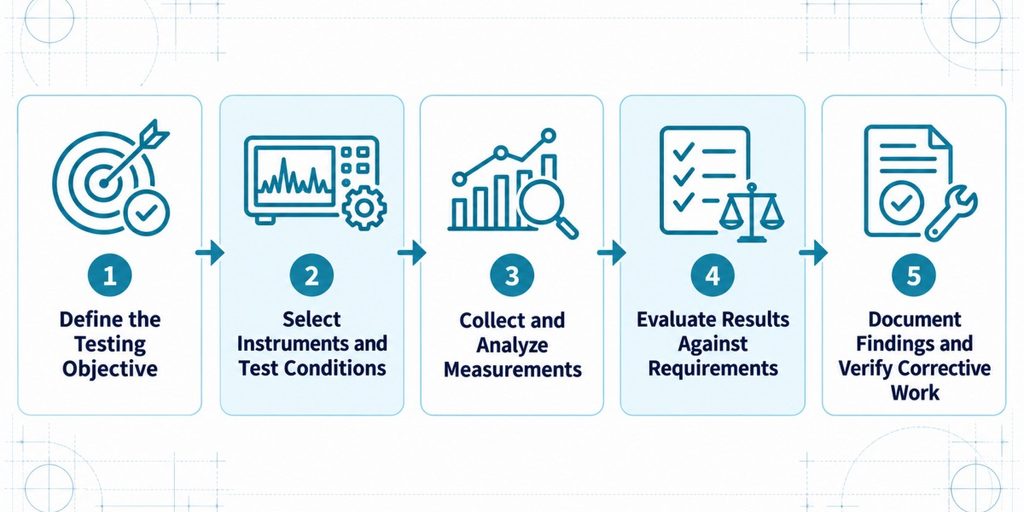
1. Define the Testing Objective
Before testing begins, engineers establish whether the project requires emissions measurements, immunity evaluation, site characterization, interference investigation, or shielding verification.
They review equipment specifications, drawings, operating requirements, reported problems, and any applicable standards.
This step also identifies the acceptance criteria and helps determine the necessary test locations and operating conditions.
2. Select Instruments and Test Conditions
Testing instruments are selected to match the electromagnetic characteristics being investigated.
Depending on the application, equipment may include field probes, magnetic field meters, antennas, EMI receivers, spectrum analysers, or other specialized instruments.
Calibration status, frequency coverage, measurement range, and test configuration must be considered.
For site investigations, engineers also establish representative operating conditions.
A measurement taken when a facility is operating at reduced electrical load may not represent conditions during normal production or peak demand.
3. Collect and Analyze Measurements
Engineers collect measurements at the relevant locations and operating states.
Depending on the objective, this may involve frequency sweeps, repeated measurements, spatial mapping, or monitoring over time.
For RF investigations, radio frequency surveys can characterize signals across relevant frequencies and help identify unexpected emissions or changing RF conditions.
Measurements may also be compared while suspected equipment is operating and inactive, where such comparisons are safe and practical.
These observations help narrow down possible sources and determine whether further investigation is necessary.
4. Evaluate Results Against Requirements
Measured values are compared with the applicable criteria established during project scoping.
This may involve specified emission limits, equipment immunity performance, manufacturer siting requirements, or owner-defined electromagnetic limits.
The result is not necessarily a simple pass or fail.
A site survey may identify conditions requiring further analysis without demonstrating an equipment malfunction. A compliance test, by contrast, may have a defined pass/fail framework.
Results must therefore be interpreted according to the purpose of the assessment.
5. Document Findings and Verify Corrective Work
A useful engineering report identifies the test objective, methodology, instrument details, measurement locations, operating conditions, results, and applicable criteria.
It should also explain limitations and identify where additional investigation is required.
If corrective measures are installed, engineers may repeat selected measurements under comparable conditions to assess their effectiveness.
C-INTECH’s EMF and RF shielding process includes the progression from assessment and engineering design to implementation and verification.
EMI and EMC Standards: Why the Correct Framework Matters
Standards provide measurement procedures and technical requirements, but no single standard applies to every EMI or EMC investigation.
The relevant framework depends on the equipment type, application, jurisdiction, and intended purpose of the testing.
Product-level standards may define emissions limits or immunity procedures.
Site investigations may instead use manufacturer siting requirements, project specifications, and engineering assessment criteria.
Shielding verification introduces another distinction.
For example, IEEE 299-2006 describes measurement methods for evaluating the shielding effectiveness of electromagnetic enclosures. It is currently classified by IEEE as inactive-reserved, while a revision project is active. Its use should therefore be confirmed against the project’s governing requirements.
Selecting the appropriate procedure during project scoping helps prevent measurements that do not answer the required engineering question.
What Happens When an EMI or EMC Problem Is Found?
Test results help determine the appropriate corrective action.
Engineers first establish whether the problem involves emissions from a source, susceptibility of the affected equipment, or electromagnetic coupling through a particular pathway.
The next step depends on the findings.
If a disturbance travels through electrical conductors, filtering or changes to wiring arrangements may be appropriate.
If equipment is exposed to excessive magnetic fields, increased separation, relocation, or magnetic field mitigation may be considered. If equipment is exposed to excessive power-frequency magnetic fields, increased separation, relocation or ELF field mitigation may be considered.
For RF-related problems, cable treatment, source control, or shielding may be necessary.
The effectiveness of electromagnetic shielding depends on the field type, frequency range, installation arrangement, and required attenuation.
Where low-frequency magnetic fields are involved, magnetic shielding for sensitive facilities requires engineering evaluation of the source conditions and proposed shielding configuration.
Corrective measures should be verified through appropriate follow-up testing rather than assumed to work after installation.
When Should EMI or EMC Testing Be Planned?
Testing should be scheduled according to the project stage and the decisions that depend on its results.
Before construction: Establish baseline electromagnetic conditions and assess whether the planned equipment locations are appropriate.
During equipment development or qualification: Perform the emissions or immunity evaluations required by the applicable standards.
Before equipment commissioning: Verify relevant site conditions, shielding performance, or installation requirements.
During troubleshooting: Investigate equipment disturbances when operating conditions suggest possible electromagnetic interference.
After modifications: Reassess performance when electrical infrastructure, equipment arrangements, shielding penetrations, or RF systems change significantly.
For projects involving several sensitive rooms or electromagnetic sources, EMF management plans can help coordinate assessment requirements and verification activities throughout the project.
Reliable Testing Requires Clear Objectives
EMI and EMC testing provide different forms of technical evidence, from emissions measurements and equipment immunity results to site conditions and shielding performance.
The quality of an assessment depends on choosing suitable instruments, representative test conditions, and applicable acceptance criteria.
For facilities containing sensitive equipment, testing helps determine whether the electromagnetic environment is compatible with the intended installation and whether corrective work has achieved the required improvement.
If your project requires electromagnetic measurements, RF investigation, or shielding verification, contact C-INTECH to discuss the appropriate engineering assessment.
Frequently Asked Questions
1. Can EMI problems appear even if equipment passed EMC testing before installation?
Yes. Laboratory EMC tests evaluate equipment under specified conditions. An installation may introduce other disturbances, different cable arrangements, or electromagnetic conditions beyond those represented in the original tests.
2. Can changing electrical loads make EMI problems intermittent?
Yes. Disturbances can vary with electrical loads, equipment switching, and operating cycles. Measurements may need to cover several operating states or longer observation periods to identify intermittent conditions.
3. Is shielding always the first solution when EMI is detected?
No. The test findings should establish the likely source and coupling path before mitigation is selected. Filtering, separation, equipment relocation, cable changes, or source reduction may address the issue without additional shielding.
4. Can one instrument measure every type of EMI or EMC issue?
No. Different instruments are required for different field types, frequency ranges, and measurement objectives. Formal product immunity testing also requires controlled test equipment that is not interchangeable with ordinary site survey instruments.
5. Should EMI or EMC testing be repeated after facility modifications?
Retesting may be appropriate when modifications could change electromagnetic conditions or affect previously verified shielding performance. The scope should reflect the modifications, affected equipment, and original acceptance criteria.
